Choose your class
Every subject is laid out chapter by chapter. Each topic has a short Doodle video, notes you can download and a quick quiz.
Class 9Motion, matter, the cell and number systems: the foundations of school science and maths.ScienceMathematics21 videosClass 10Light, electricity, chemical reactions, life processes and the algebra and geometry of board year.ScienceMathematics9 videosClass 11Mechanics, thermodynamics, atomic structure, bonding, functions and the living world.PhysicsChemistryMathematicsBiology16 videosClass 12Electromagnetism, optics, modern physics, solutions and kinetics, calculus and genetics.PhysicsChemistryMathematicsBiology38 videosExtra / SupplementaryCurious questions beyond the syllabus: why the sky is blue, why we yawn, why 0.999… equals 1, and more.ScienceBiologyMathematics11 videos
Newest videos
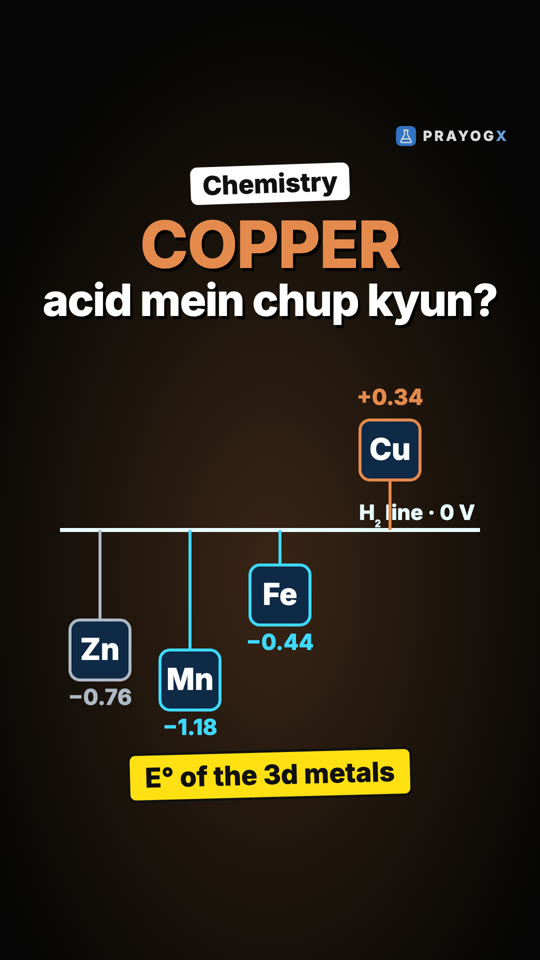 Zinc Fizzes, Copper Stays Silent: Electrode Potentials of the 3d MetalsCopper is the only 3d metal with a positive E°(M²⁺/M) (+0.34 V), so it gives no H₂ with dilute acids. Turning Cu(s) into Cu²⁺(aq) costs more (atomisation + two ionisations) than hydration pays back: 921 against zinc's 711 kJ/mol. Stable d⁵ and d¹⁰ bend the trend: Mn and Zn dip, Mn³⁺ is a strong oxidant, Fe³⁺ is stable.The d- and f-Block Elements · Chemistry
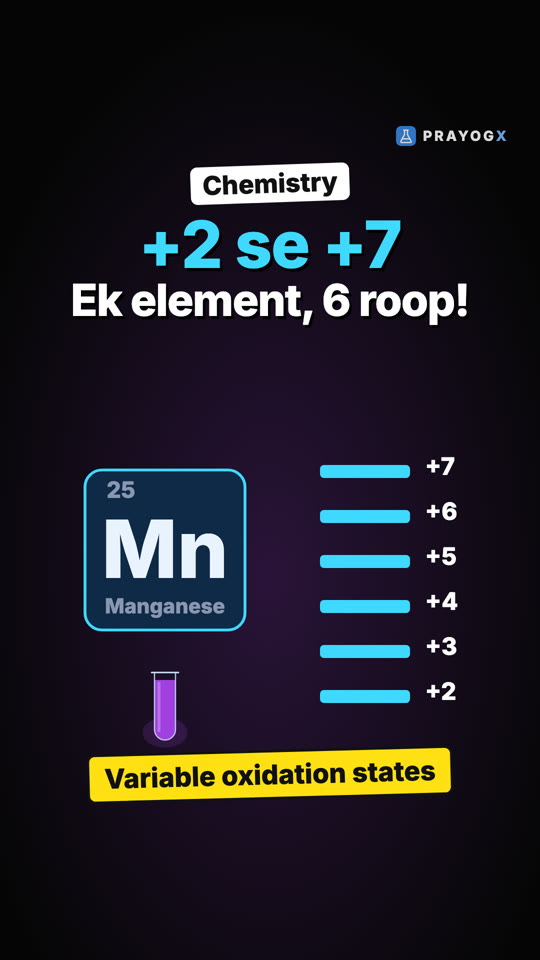 One Element, Six Oxidation States: Why Transition Metals VaryThe ns and (n−1)d electrons of a transition metal are close in energy, so both can take part in bonding. Manganese (3d⁵ 4s²) shows every state from +2 to +7; the most states occur in the middle of the series, Sc shows only +3 and Zn only +2, and the states change in steps of one.The d- and f-Block Elements · Chemistry
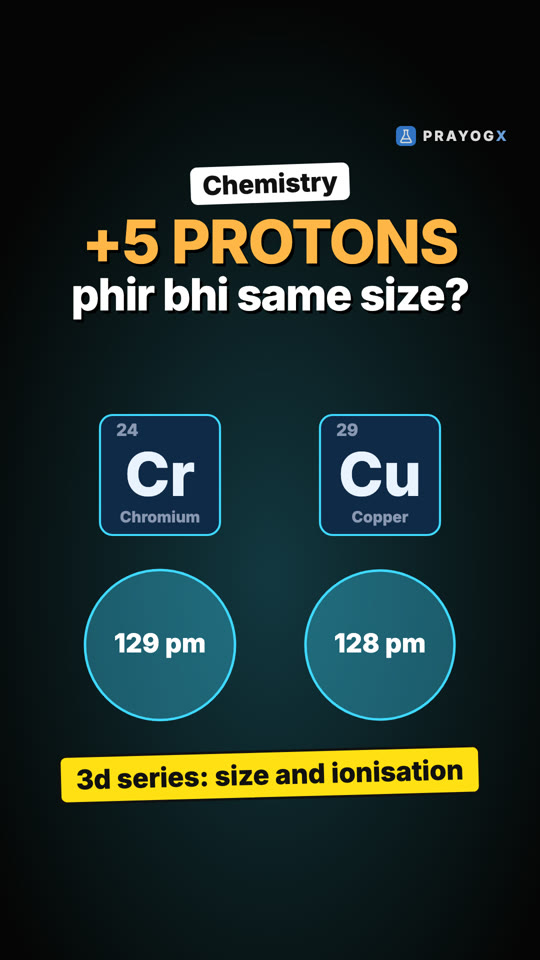 Five More Protons, Same Size: Radius and Ionisation Enthalpy across the 3d SeriesAcross the 3d series each new electron enters the inner (n−1)d subshell and shields the outer 4s electrons, nearly cancelling the extra nuclear charge. So atomic radii change only slightly and the first ionisation enthalpy rises slowly (631 → 906 kJ/mol), unlike across a normal period.The d- and f-Block Elements · Chemistry
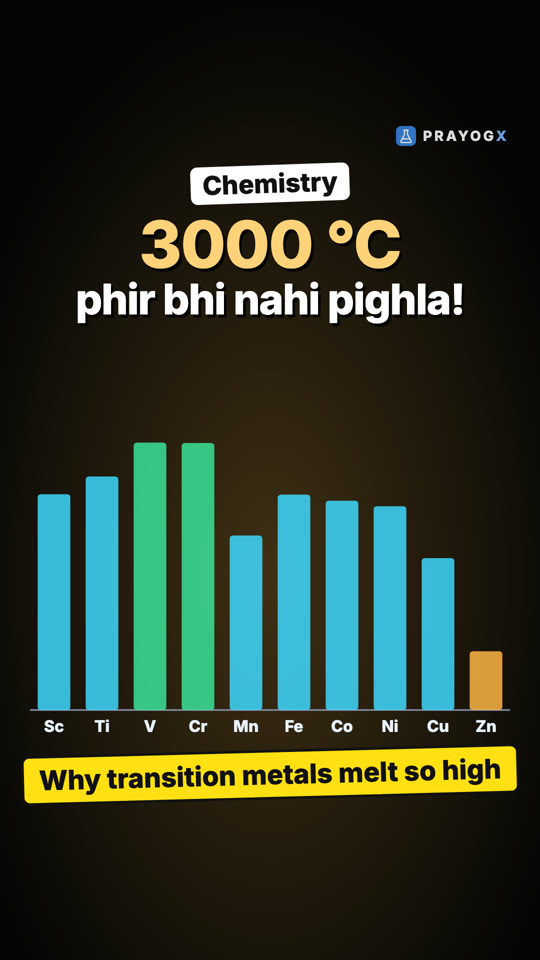 Why Transition Metals Have High Melting PointsIn transition metals the (n−1)d electrons join the ns electrons in metallic bonding, so the bonds are strong and the metals are hard with high melting points. Across the 3d series melting points peak near the middle (Mn is an exception) and fall to zinc (d¹⁰).The d- and f-Block Elements · Chemistry
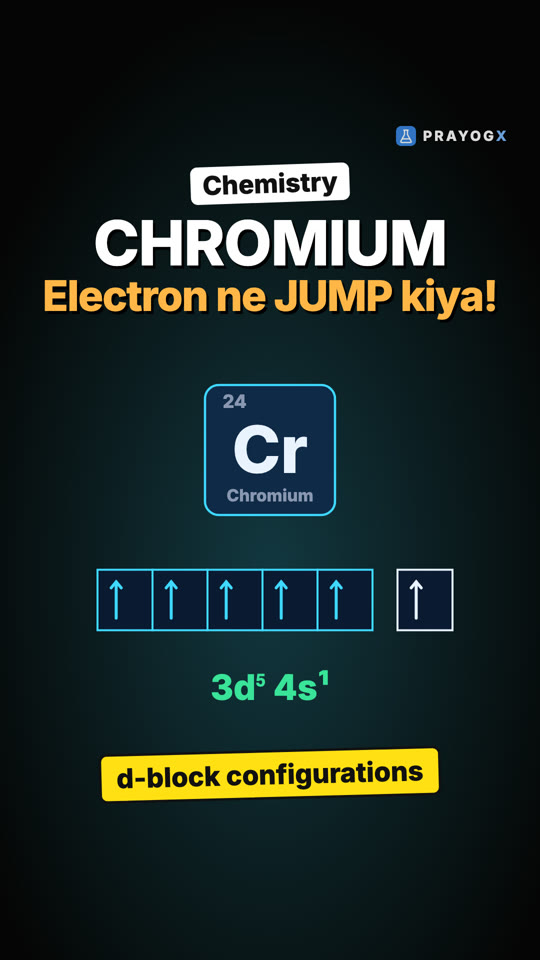 d-Block Configurations: Why Chromium and Copper Break the RuleThe d-block's general configuration is (n−1)d¹⁻¹⁰ ns¹⁻², with 4s filling before 3d. Chromium (3d⁵4s¹) and copper (3d¹⁰4s¹) move one 4s electron into 3d, because 3d and 4s are very close in energy and half-filled and full d sets are extra stable.The d- and f-Block Elements · Chemistry
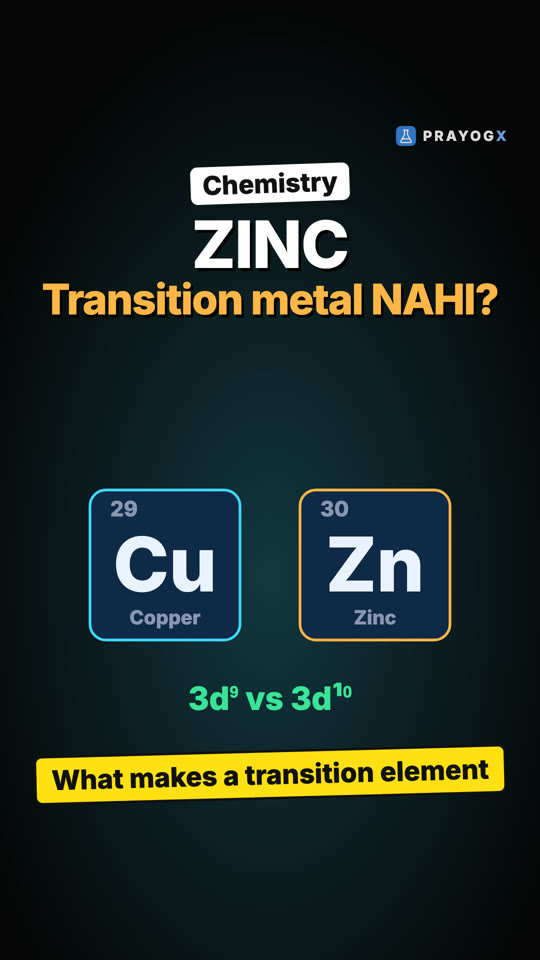 Zinc Is in the d-Block, So Why Is It Not a Transition Metal?A transition element has an incompletely filled d subshell in its atom or in a common ion. Iron (3d⁶) passes; copper (3d¹⁰ atom) passes through Cu²⁺ (3d⁹); zinc stays 3d¹⁰ even as Zn²⁺, so Zn, Cd and Hg are d-block but not transition metals.The d- and f-Block Elements · Chemistry