Chapter 7 · Physics
Motion
Distance, displacement, speed, velocity, acceleration and the graphs of motion.
Start with: Motion: Chapter IntroductionTopics in this chapter
- 1
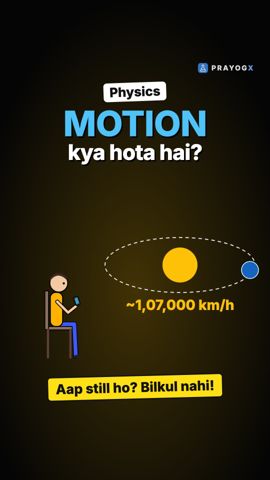 Motion: Chapter IntroductionSitting still? With the Earth you are moving at about 1,500 km/h. Motion is a change of position with time, measured from a reference point, and this chapter gives the tools to describe it. Watch
- 2
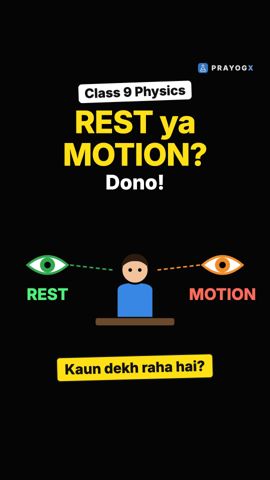 Rest and Motion: Motion is RelativeAre you moving right now? It depends on who is watching. Rest and motion are always measured from a reference point. Watch
- 3
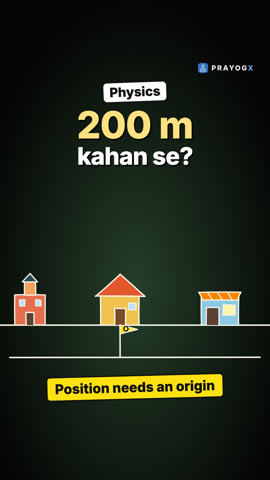 Position Needs an Origin and a Direction"200 m" means nothing until you say from where and which way. Position is a signed number with a unit, measured from a chosen origin. Watch
- 4
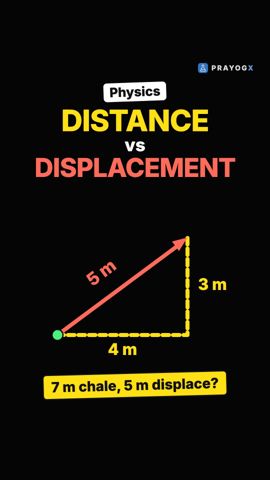 Distance vs DisplacementDistance counts the whole path you walked; displacement only looks at the straight line from start to end, with its direction. Watch
- 5
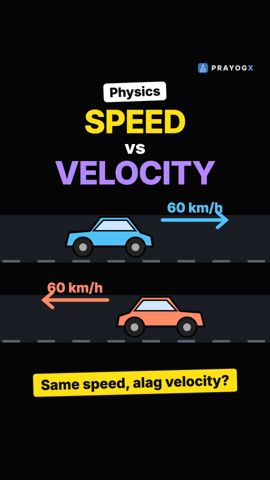 Speed vs VelocityTwo cars at the same 60 km/h can have different velocities. Speed tells how fast; velocity also tells which way. Watch
- 6
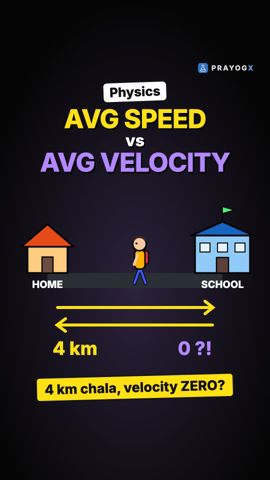 Average Speed vs Average VelocityWalk 4 km to school and back in an hour: average speed 4 km/h, average velocity zero. One uses total distance, the other displacement. Watch
- 7Uniform and non-uniform motionComing soon
- 8Acceleration: what it really meansComing soon
- 9Positive, negative and zero accelerationComing soon
- 10Retardation or decelerationComing soon
- 11Distance–time graph: reading motionComing soon
- 12Velocity–time graph: reading motionComing soon
- 13Slope of a distance–time graphComing soon
- 14Slope of a velocity–time graphComing soon
- 15Area under a velocity–time graphComing soon
- 16How to interpret a flat, rising or falling graphComing soon
- 17Instantaneous speed (intuitive introduction)Coming soon
- 18Scalar and vector quantitiesComing soon
- 19SI units of distance, speed, velocity and accelerationComing soon
- 20Why a round trip can have zero displacement but non-zero distanceComing soon