Mathematics
Pascal's Triangle and Number Patterns
Video not playing? YouTube
One simple rule builds a triangle full of patterns: powers of 2, triangular numbers, Fibonacci and more. And India wrote it down centuries before Pascal.
Download the short notesPDF, 167 KB · solved examples, practice set and answer key Download the workbook
PDF, 176 KB · fill in the blanks, true/false, assertion-reason, MCQ, numericals, short answer, match the columns; detailed solutions at the end That's all the videos in this chapter so far Back to Number patterns
Key points
- The rule: each number is the sum of the two numbers above it.
- Row sums are powers of 2: 1, 2, 4, 8, 16.
- Diagonals give natural numbers and triangular numbers 1, 3, 6, 10.
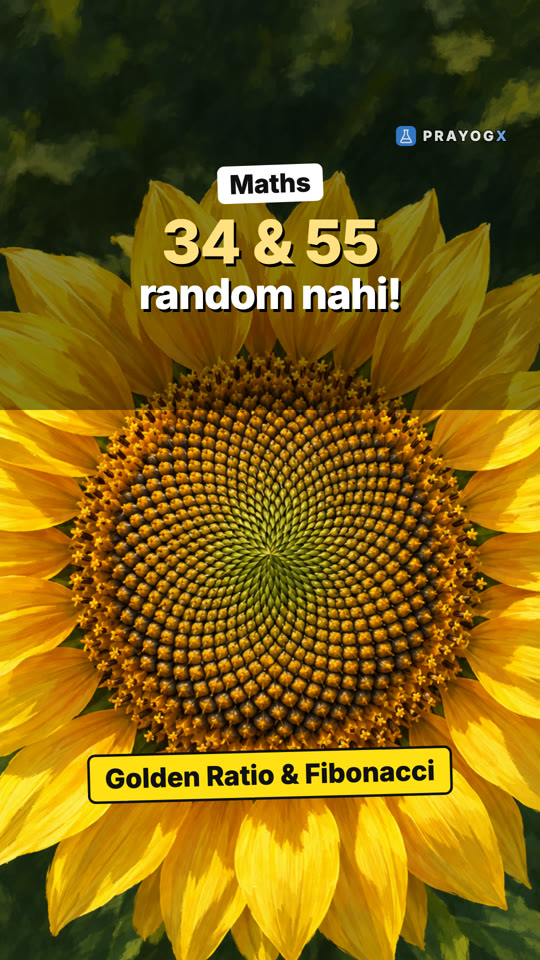
- Slanted lines add up to the Fibonacci numbers.
- Row n gives the coefficients of (a + b)ⁿ.
- In India it appears as Meru Prastara, centuries before Pascal.
Where to look
| Look at | You find |
|---|---|
| Row sums | 1, 2, 4, 8, 16 |
| Second diagonal | 1, 2, 3, 4, 5 |
| Third diagonal | 1, 3, 6, 10 |
| Slanted lines | 1, 1, 2, 3, 5, 8 |
| Row 2 | 1, 2, 1: coefficients of (a + b)² |
Try it yourself
Goal: Explore the triangle: check the rule, then find the patterns hidden in it.
- Tap a number to see the two above it.
- Switch patterns: row sums, diagonals, Fibonacci.
- Tap rows or lines to test them.
- Choose Odd numbers and add rows to see the Sierpinski pattern.
Quick quiz
3 questions. Choose an answer for each, then submit to see your score and the explanations.