Chapter 9 · Physics
Regular vs Diffused Reflection
Video not playing? Watch on Instagram · YouTube
A mirror and a white wall both reflect light; only the mirror shows your face. Smooth surfaces keep rays parallel; rough ones scatter them.
Download the short notesPDF, 108 KB · solved examples, practice set and answer key Download the workbook
PDF, 170 KB · fill in the blanks, true/false, assertion-reason, MCQ, numericals, short answer, match the columns; detailed solutions at the end Up next in this chapter
 Image Formed by a Plane MirrorStand 2 m from a mirror and your image is 4 m from you. Why a plane mirror's image is virtual, erect, the same size, as far behind as you are in front, and laterally inverted.Physics · simulation
Key points
- Smooth surface → parallel rays stay parallel → image: regular reflection.
- Rough surface → rays scatter → no image: diffused reflection.
- Each ray still obeys i = r at its own tiny facet.
- Diffused reflection lets us see a book from any angle; a wet road becomes smoother and glares.
Smooth vs rough
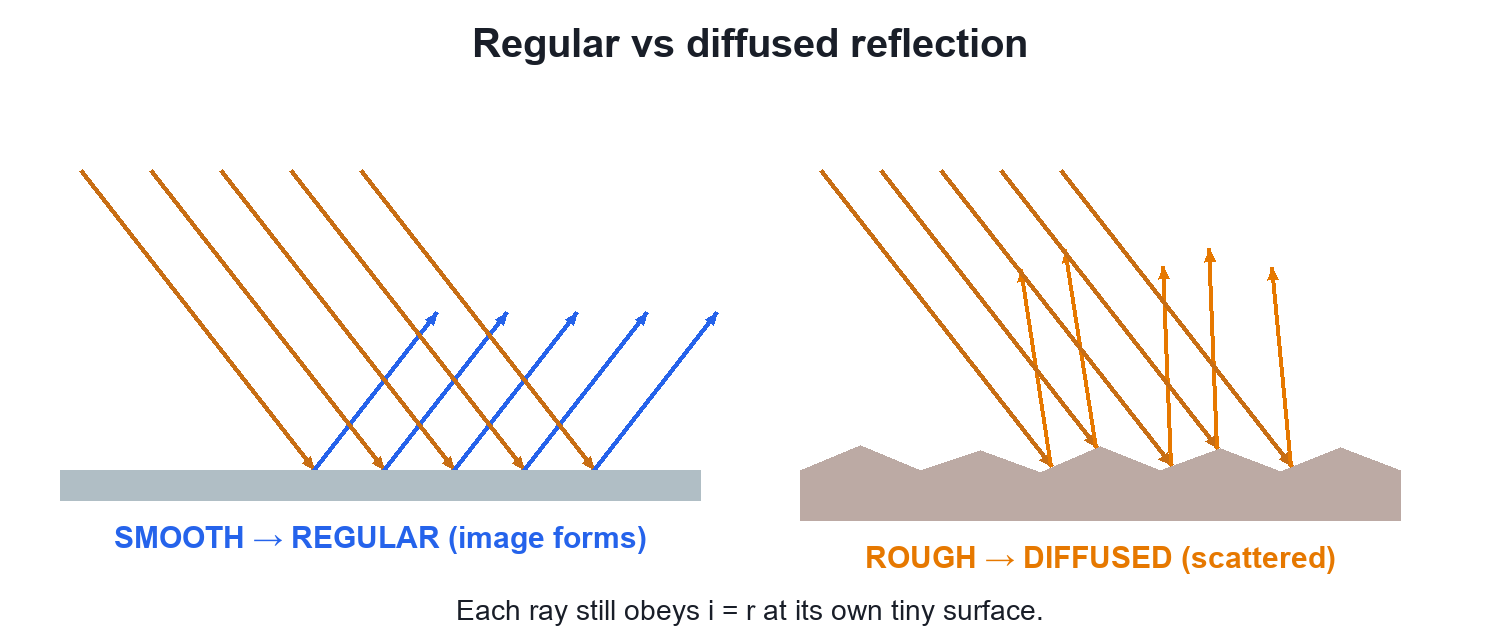
| Feature | Regular | Diffused |
|---|---|---|
| Surface | Smooth | Rough |
| Reflected rays | Parallel | Scattered |
| Image | Forms | Does not form |
| Laws of reflection | Obeyed | Obeyed at every facet |
Try it yourself
Goal: See how surface roughness turns regular reflection into diffused reflection.
- Start with the slider at 0% (smooth).
- Increase the roughness and watch the reflected rays spread.
- Check the readout: every ray still has i = r.
Quick quiz
4 questions. Choose an answer for each, then submit to see your score and the explanations.
More from Light – Reflection and Refraction
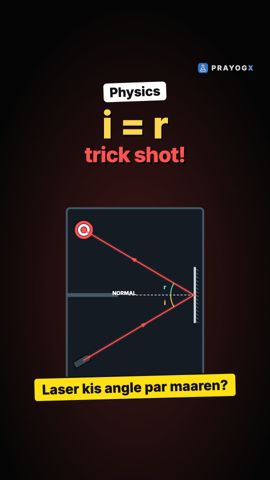 Laws of ReflectionTo hit a hidden target with a laser and a mirror you need 2 rules: i = r (both measured from the normal) and all three rays in one plane.Physics · simulation
 Reflection of LightThe Moon makes no light, yet it shines at night: sunlight bounces off it to our eyes. That bouncing back is reflection.Physics
 Light: Chapter IntroductionWe see things because light bounces off them into our eyes. At a surface light has 2 options: bounce back (reflection) or go in and bend (refraction).Physics
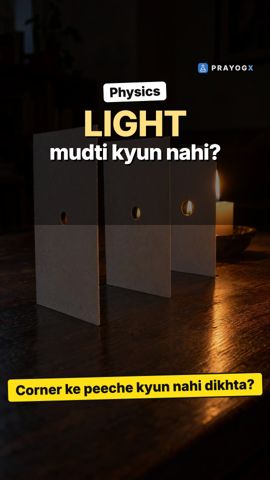 Light Travels in Straight LinesYou can hear a friend round a corner but not see them: sound bends, light travels in straight lines. We draw its path as a ray.Physics