Chapter 1 · Biology
Sexual Reproduction in Flowering Plants: Chapter Introduction
Video not playing? YouTube
A flower is a plant's reproductive organ. Pollen reaches the stigma, a pollen tube delivers two male gametes, double fertilisation follows, and the ovule becomes a seed and the ovary a fruit.
Download the short notesPDF, 153 KB · solved examples, practice set and answer key Download the workbook
PDF, 180 KB · fill in the blanks, true/false, assertion-reason, MCQ, numericals, short answer, match the columns; detailed solutions at the end Up next in this chapter
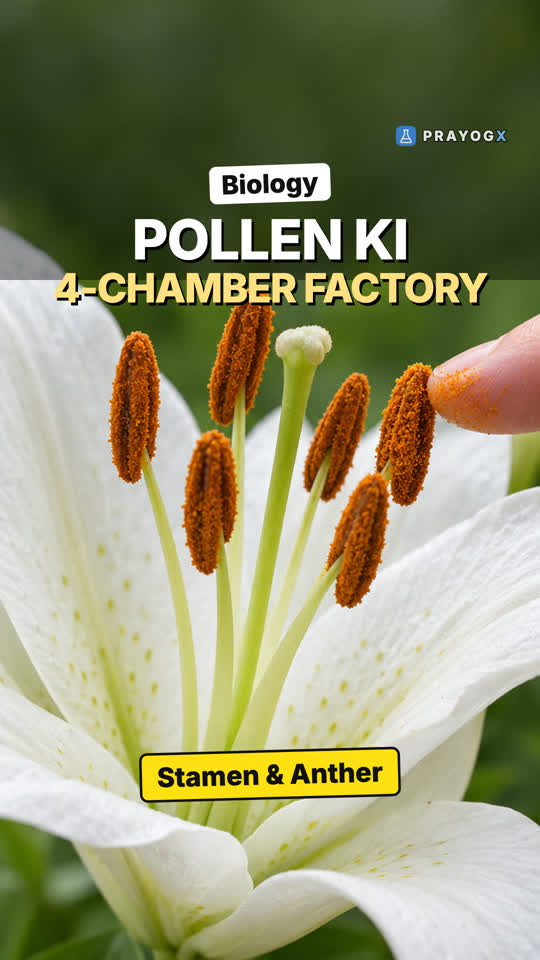 The Stamen and the Four-Chambered AntherTouch a lily and your finger turns orange. Where is that pollen made? Inside the stamen, in an anther with four chambers.Biology
Key points
- The flower is the site of sexual reproduction: stamen (male: anther + filament) and pistil (female: stigma, style, ovary).
- Pollination carries pollen from anther to stigma (wind, water, insects and other animals).
- A pollen tube grows down the style and carries two male gametes into the ovule.
- Double fertilisation: gamete + egg → zygote (2n); gamete + 2 polar nuclei → primary endosperm nucleus (3n). Ovule → seed, ovary → fruit.
Parts of the flower
| Whorl | Parts | Role |
|---|---|---|
| Stamen (androecium) | anther, filament | pollen grains form in the anther |
| Pistil (gynoecium) | stigma, style, ovary | receives pollen; ovules in the ovary |
From pollination to fertilisation
- Pollination: pollen lands on a compatible stigma (self- or cross-pollination).
- The pollen grain germinates; the pollen tube grows through the style and enters the ovule.
- It releases two male gametes into the embryo sac.
Double fertilisation
male gamete + egg → zygote (2n) male gamete + 2 polar nuclei → PEN (3n)
Syngamy and triple fusion together form double fertilisation, characteristic of flowering plants. The zygote grows into the embryo, the primary endosperm nucleus into the endosperm that feeds it.
After fertilisation
- Ovule → seed; ovary → fruit.
- Apomixis: some plants form seeds without fertilisation.
Quick quiz
4 questions. Choose an answer for each, then submit to see your score and the explanations.