Chapter 1 · Physics
The SI System: Seven Base Units
Video not playing? YouTube
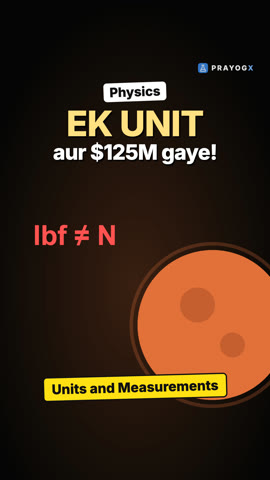
In 1999 NASA lost the Mars Climate Orbiter because one team used pound-force and another newtons. Why the world uses one system, the SI, built on seven base units.
Download the short notesPDF, 183 KB · solved examples, practice set and answer key Download the workbook
PDF, 185 KB · fill in the blanks, true/false, assertion-reason, MCQ, numericals, short answer, match the columns; detailed solutions at the end That's all the videos in this chapter so far Back to Units and Measurement
Key points
- Mars Climate Orbiter (1999) was lost because one team's software gave impulse in pound-force seconds while the navigation team expected newton seconds.
- The SI (Système International, 1960) is the one system of units used worldwide in science.
- It has seven base units: metre (m), kilogram (kg), second (s), ampere (A), kelvin (K), mole (mol), candela (cd).
- Every other unit is derived: newton N = kg m s⁻² (from F = ma), joule J = N m = kg m² s⁻².
The seven base quantities
| Quantity | Unit | Symbol |
|---|---|---|
| Length | metre | m |
| Mass | kilogram | kg |
| Time | second | s |
| Electric current | ampere | A |
| Thermodynamic temperature | kelvin | K |
| Amount of substance | mole | mol |
| Luminous intensity | candela | cd |
Some derived units
| Quantity | Unit | In base units |
|---|---|---|
| Force | newton (N) | kg m s⁻² |
| Work, energy | joule (J) | kg m² s⁻² |
| Power | watt (W) | kg m² s⁻³ |
| Pressure | pascal (Pa) | kg m⁻¹ s⁻² |
| Charge | coulomb (C) | A s |
Quick quiz
3 questions. Choose an answer for each, then submit to see your score and the explanations.