Biology
Why Do We Get Goosebumps?
Video not playing? Watch on Instagram · YouTube
A tiny muscle at the base of each hair, the arrector pili, contracts in cold or fear: the hair stands up and the skin around it rises into a bump.
Download the short notesPDF, 141 KB · solved examples, practice set and answer key Download the workbook
PDF, 170 KB · fill in the blanks, true/false, assertion-reason, MCQ, numericals, short answer, match the columns; detailed solutions at the end Up next in this chapter
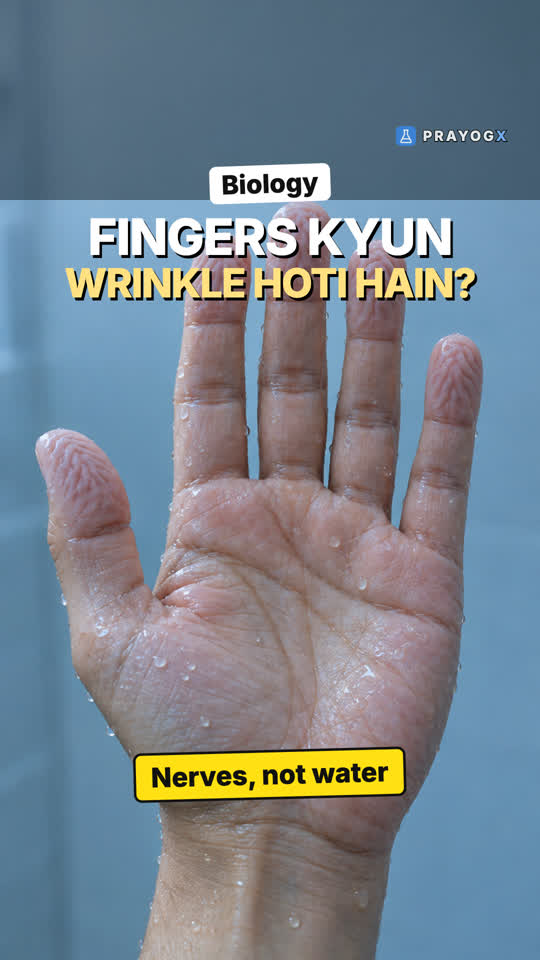 Why Do Fingers Wrinkle in Water?Skin soaking up water is not the full story: a finger with nerve damage stays smooth. How the nervous system makes wrinkles, and why their purpose is still debated.Biology
Key points
- Each hair follicle has a tiny smooth muscle, the arrector pili.
- Cold or strong emotion fires sympathetic nerves and releases adrenaline; the muscle contracts involuntarily.
- The hair stands upright and the skin around it bunches into a bump: a goosebump.
- In furry animals raised fur traps air (insulation) and makes them look bigger; in humans it is mostly a leftover reflex, though the same nerve-muscle pair helps hair regrow in long cold (research, 2020).
The mechanism
- Trigger: cold, fear, or a strong emotion (even music).
- Sympathetic nerves fire and adrenaline is released.
- The arrector pili (smooth, involuntary muscle) contracts.
- It pulls the slanted follicle upright: the hair stands, the skin above rises into a bump.
Why animals have it
| Effect | Benefit |
|---|---|
| Raised fur traps a thicker air layer | Insulation against cold |
| Fur fluffs out (cat, porcupine quills) | Looks bigger to a threat |
Humans have too little body hair for either effect, so the reflex is largely a leftover from furry ancestors.
Quick quiz
4 questions. Choose an answer for each, then submit to see your score and the explanations.