Chapter 1 · Mathematics
Relations and Functions: Chapter Introduction
Video not playing? YouTube
Roll numbers and birthdays are both functions, but only roll numbers are one-one. The chapter classifies relations and functions and shows which functions can be reversed.
Download the short notesPDF, 182 KB · solved examples, practice set and answer key Download the workbook
PDF, 187 KB · fill in the blanks, true/false, assertion-reason, MCQ, numericals, short answer, match the columns; detailed solutions at the end Up next in this chapter
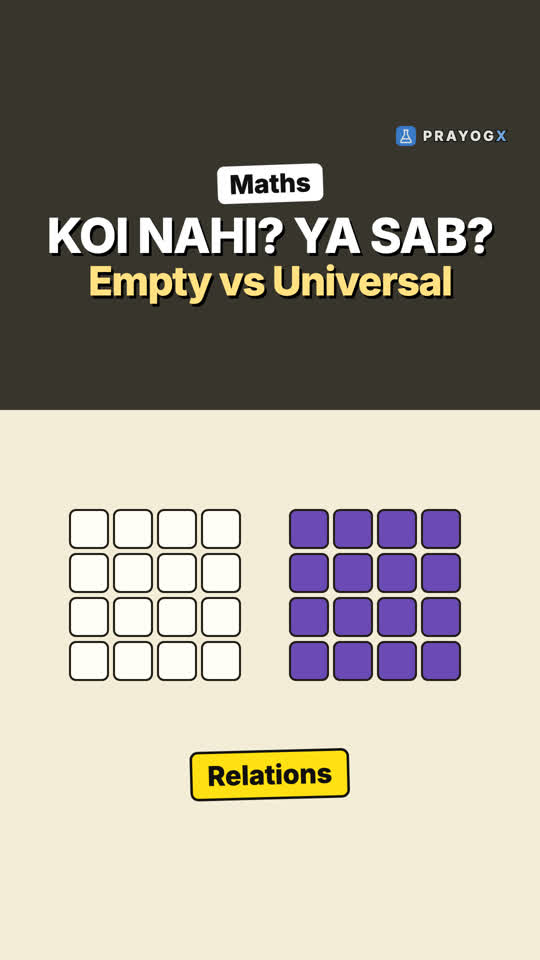 Empty and Universal RelationsIn a boys' school, who is whose sister? Nobody, and Maths has a name for that. What a relation is, and its two extreme cases.Mathematics · simulation
Key points
- A relation from A to B is any set of pairs (a subset of A × B); a function gives each input exactly one output.
- One-one: different inputs give different outputs (roll numbers). Birthdays are a function but many-one.
- Onto: every element of B is an output. Bijective = one-one + onto; only bijective functions have an inverse.
- A relation that is reflexive, symmetric and transitive is an equivalence relation ("is in the same class as").
Relation vs function
| Arrows from A | Function? |
|---|---|
| a → 1 and a → 3 | No: a has two outputs |
| each element has exactly one arrow | Yes |
| c has no arrow | No: every input needs an output |
Types of functions
| Type | Meaning | Example |
|---|---|---|
| One-one (injective) | different inputs → different outputs | student → roll number |
| Many-one | two inputs share an output | student → birthday |
| Onto (surjective) | every element of B is used | roll numbers 1-4 for 4 students |
| Bijective | one-one and onto | invertible |
f(x) = 2x + 3 on ℝ is bijective; f⁻¹(y) = (y − 3) / 2
Types of relations
- Reflexive: (a, a) ∈ R for every a.
- Symmetric: (a, b) ∈ R ⇒ (b, a) ∈ R.
- Transitive: (a, b), (b, c) ∈ R ⇒ (a, c) ∈ R.
- All three together: equivalence relation, e.g. "lives in the same city as".
What the chapter covers
- Types of relations: empty, universal, reflexive, symmetric, transitive, equivalence.
- Types of functions: one-one, onto, bijective.
- Composition of functions g∘f and invertible functions.
Quick quiz
4 questions. Choose an answer for each, then submit to see your score and the explanations.