Chapter 8 · Chemistry
Why Carboxylic Acids Are Acidic: Resonance and Substituents
Video not playing? YouTube
Why vinegar fizzes with baking soda: the carboxylate ion shares its charge equally between two oxygens (resonance, arrow by arrow), which makes carboxylic acids stronger than phenols and alcohols; electron-withdrawing groups such as chlorine make them stronger still.
Download the short notesPDF, 174 KB · solved examples, practice set and answer key Download the handwritten notes
PDF, 829 KB · every board page from the video, written out in chalk Download the workbook
PDF, 182 KB · fill in the blanks, true/false, assertion-reason, MCQ, numericals, short answer, match the columns; detailed solutions at the end Up next in this chapter
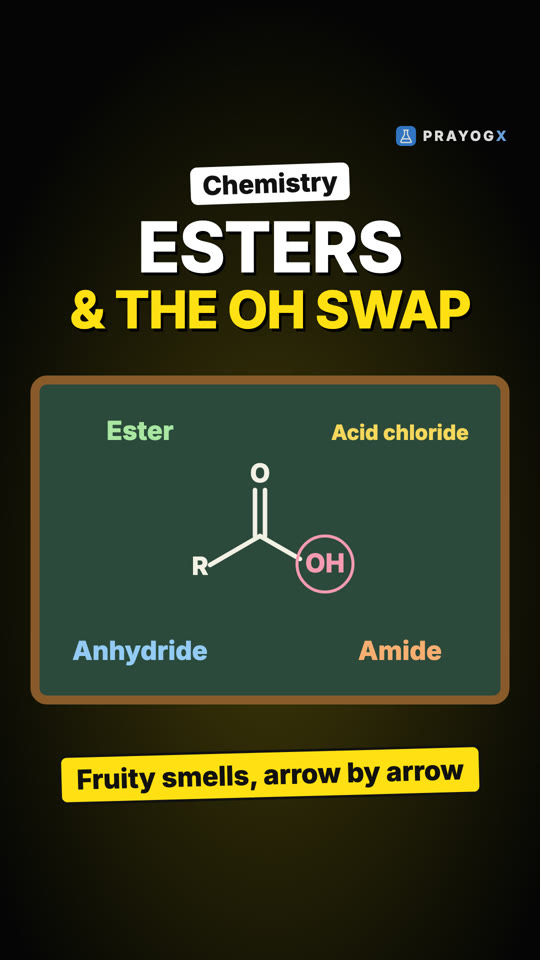 Esterification and the C–OH Swap: Esters, Acid Chlorides, Anhydrides, AmidesFruity esters from an acid and an alcohol, with the acid-catalysed mechanism drawn arrow by arrow, and three more ways to replace the –OH of –COOH: acid chlorides (best with SOCl₂), anhydrides and amides.Chemistry
Key points
- Carboxylic acids liberate CO₂ from NaHCO₃ (a test for –COOH); alcohols and phenol do not.
- RCOOH ⇌ RCOO⁻ + H⁺: the more stable the carboxylate, the stronger the acid.
- In RCOO⁻, resonance shares the charge equally between two oxygens; both C–O bonds are equal.
- Acidity: RCOOH (pKa ≈ 4.8) > phenol (≈ 10) > alcohol (≈ 16).
- Electron-withdrawing groups raise acidity (–I effect): pKa 4.8 → 2.9 → 1.3 → 0.7 for 0 → 3 Cl.
Resonance in the carboxylate ion
R–C(=O)–O⁻ ⟷ R–C(–O⁻)=O
An O⁻ lone pair moves in to make C=O; the old C=O π pair moves onto the other oxygen. The two structures are equivalent, so the charge is shared equally and the ion is stable.
Acid, phenol, alcohol
| Anion | Charge spread over | pKa of the acid |
|---|---|---|
| RCOO⁻ | two equal O atoms | ≈ 4–5 |
| C₆H₅O⁻ | O and ring carbons (less electronegative) | ≈ 10 |
| CH₃CH₂O⁻ | one O (no resonance) | ≈ 16 |
Chlorine makes it stronger
| Acid | pKa |
|---|---|
| CH₃COOH | 4.76 |
| ClCH₂COOH | 2.86 |
| Cl₂CHCOOH | ≈ 1.3 |
| Cl₃CCOOH | ≈ 0.7 |
Each Cl pulls electron density through the σ bonds (–I effect), spreading the carboxylate's charge further. Electron-donating alkyl groups do the opposite.
Quick quiz
5 questions. Choose an answer for each, then submit to see your score and the explanations.
More from Aldehydes, Ketones and Carboxylic Acids
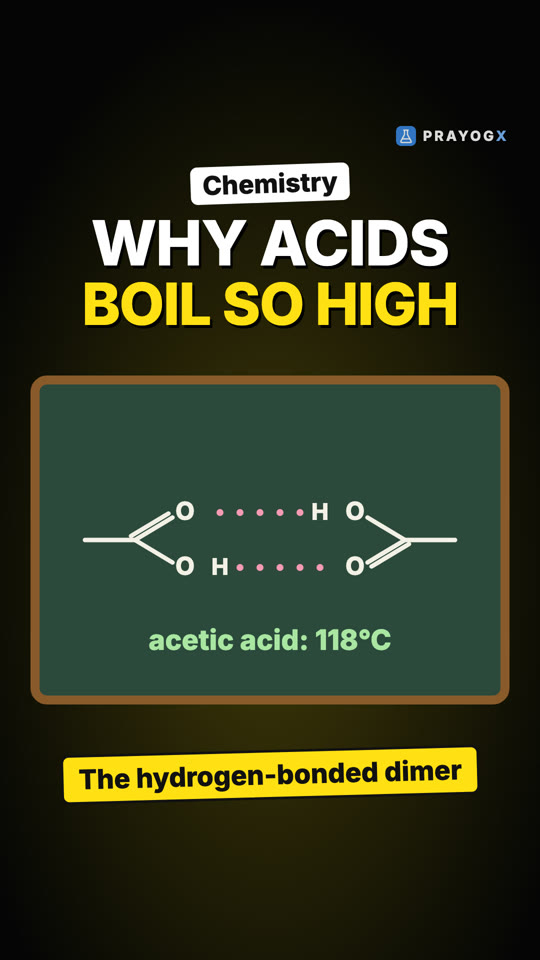 Why Carboxylic Acids Boil So High: Hydrogen-Bonded DimersFour molecules of about the same mass boil from 0 °C to 118 °C. Carboxylic acids win because two hydrogen bonds join them into dimers that survive even in the vapour; the same dimers double acetic acid's measured molar mass in benzene.Chemistry
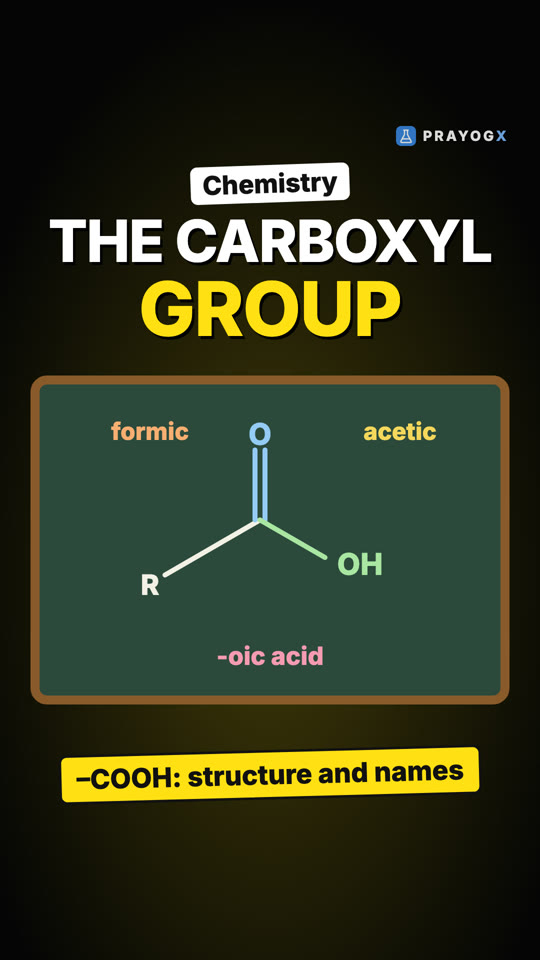 The Carboxyl Group: Structure and NamingWhat –COOH really is: a carbonyl and a hydroxyl on one sp² carbon, joined by resonance that makes the carbon less electrophilic than in aldehydes; and how carboxylic acids get their common and IUPAC names.Chemistry
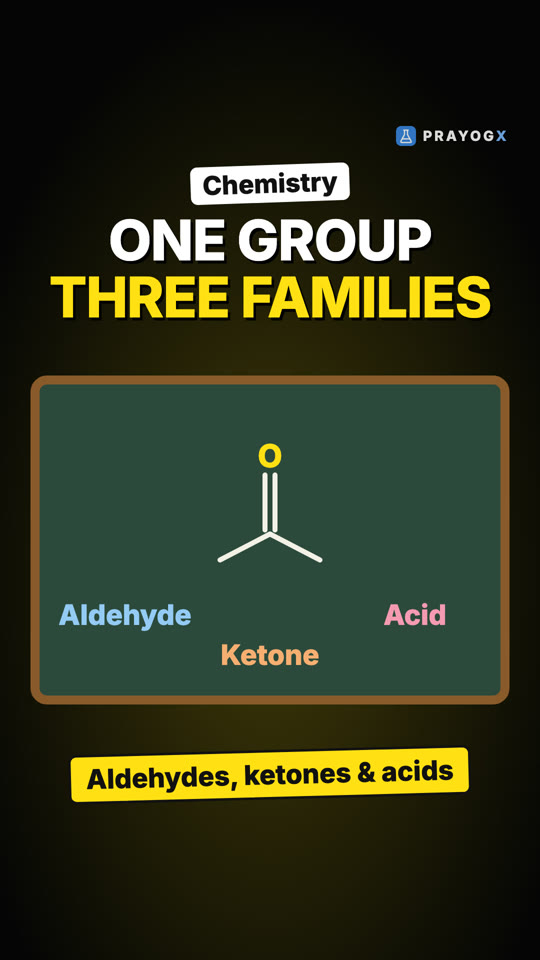 Aldehydes, Ketones and Carboxylic Acids: Chapter IntroductionVanilla, cinnamon, vinegar and nail-polish remover share one secret: the carbonyl group, C=O. What sits on the carbonyl carbon makes an aldehyde, a ketone or a carboxylic acid, and what this chapter will cover.Chemistry
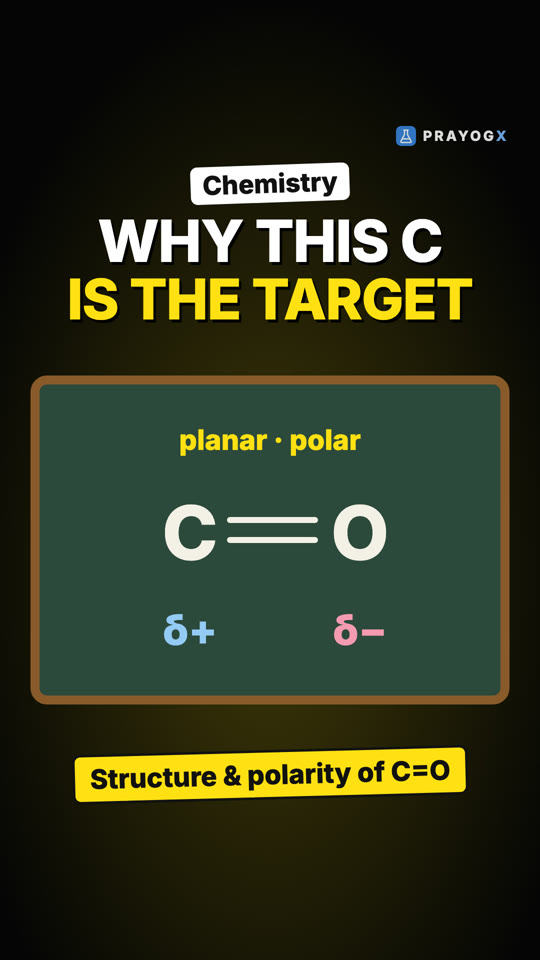 The Carbonyl Group: Structure and PolarityWhy the carbon of C=O is every nucleophile's target: an sp², planar carbon, a π bond from sideways p–p overlap, and a polar C=O with δ⁺ carbon and δ⁻ oxygen, explained by resonance.Chemistry
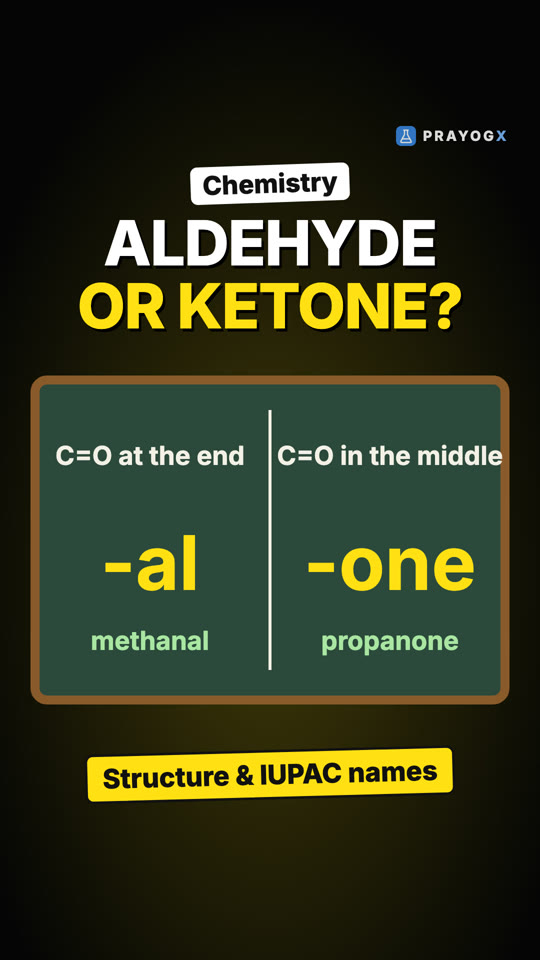 Aldehyde or Ketone? Structure and IUPAC NamesMethanal and propanone both have C=O, yet one is an aldehyde and one a ketone. Where the C=O sits decides it, and the names follow: -al for aldehydes, -one for ketones, plus the common names.Chemistry
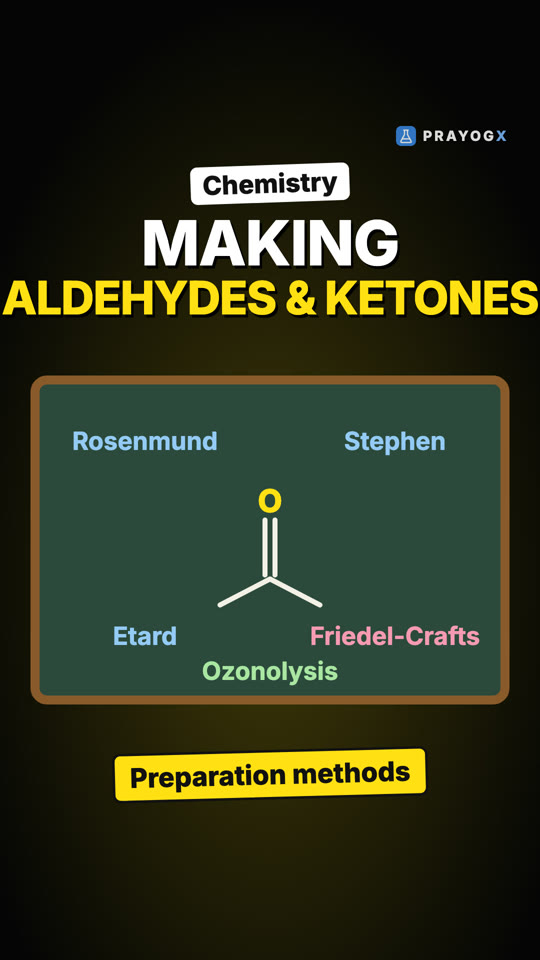 Making Aldehydes and Ketones: Methods and Named ReactionsFour routes make both aldehydes and ketones (from alcohols, alkenes and alkynes); named reactions make only one: Rosenmund, Stephen, Etard and Gatterman-Koch for aldehydes; Grignard on nitriles, dialkylcadmium and Friedel-Crafts acylation for ketones.Chemistry
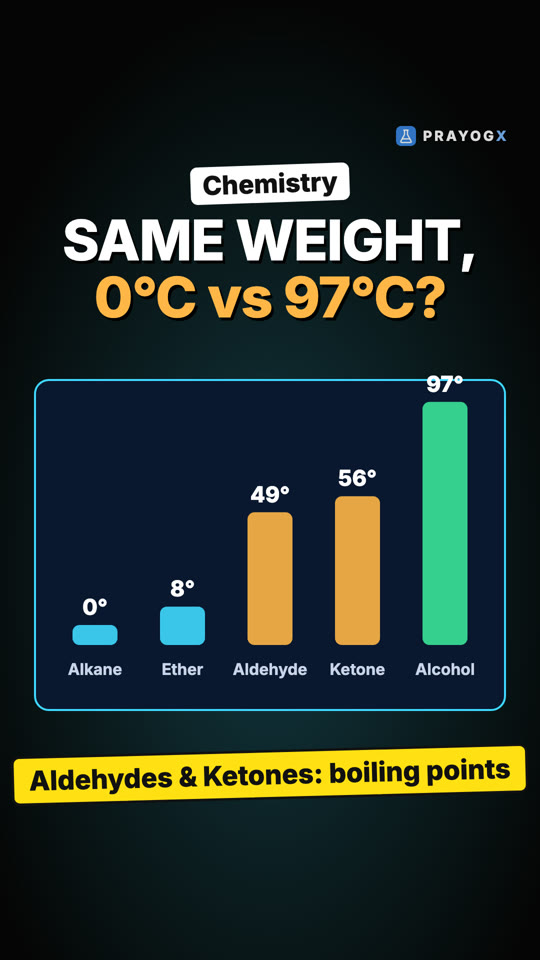 Same Weight, 0 °C vs 97 °C: Physical Properties of Aldehydes and KetonesFive compounds of the same mass boil from 0 °C to 97 °C. Aldehydes and ketones sit in the middle: their polar C=O gives dipole-dipole attraction, but with no O–H they cannot hydrogen-bond with each other. Water can hydrogen-bond to the C=O oxygen, so small aldehydes and ketones mix with water while long chains do not.Chemistry
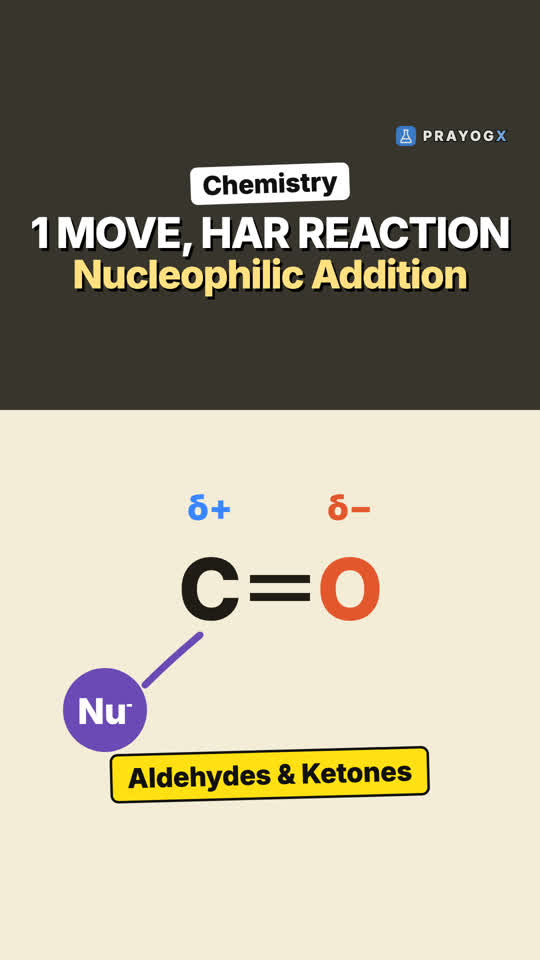 Nucleophilic Addition to the Carbonyl GroupMost reactions of aldehydes and ketones begin with one move. How a nucleophile attacks the polar C=O, and why aldehydes react faster than ketones.Chemistry
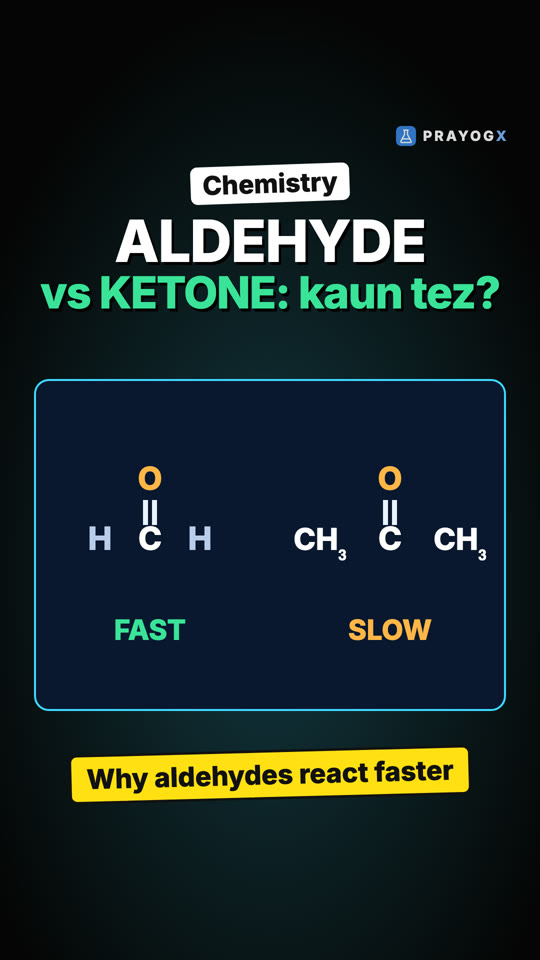 Aldehyde vs Ketone: Why Aldehydes React FasterBoth have the same C=O, yet a nucleophile attacks an aldehyde faster. Two reasons: alkyl groups push electrons (+I) and lower the carbonyl carbon's δ+, and a ketone's two groups crowd the path to it. So HCHO > CH₃CHO > CH₃COCH₃.Chemistry
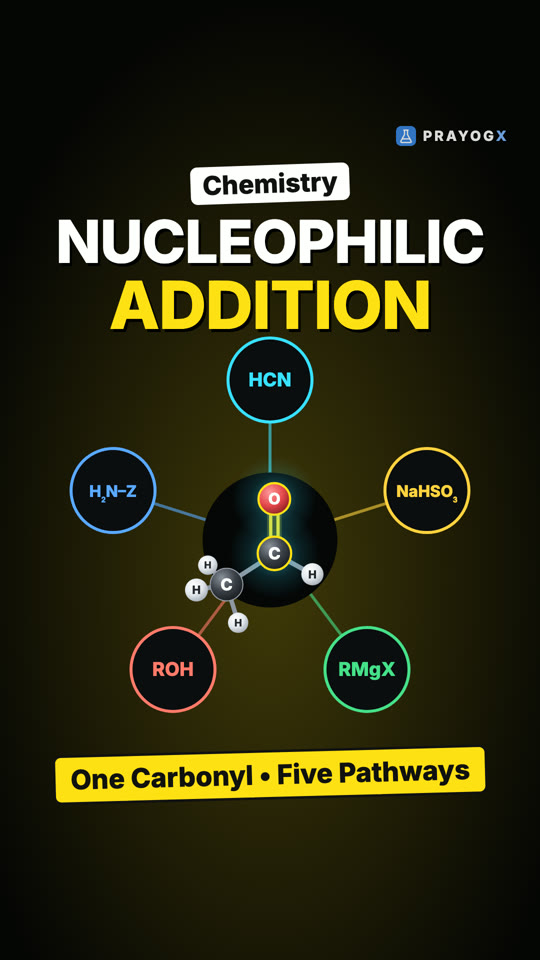 Nucleophilic Addition Reactions: One Carbonyl, Five PathwaysEvery nucleophilic addition reaction of aldehydes and ketones in one place: HCN, NaHSO₃, Grignard reagents, alcohols, and the addition–elimination of ammonia derivatives, with the product each one gives.Chemistry · simulation
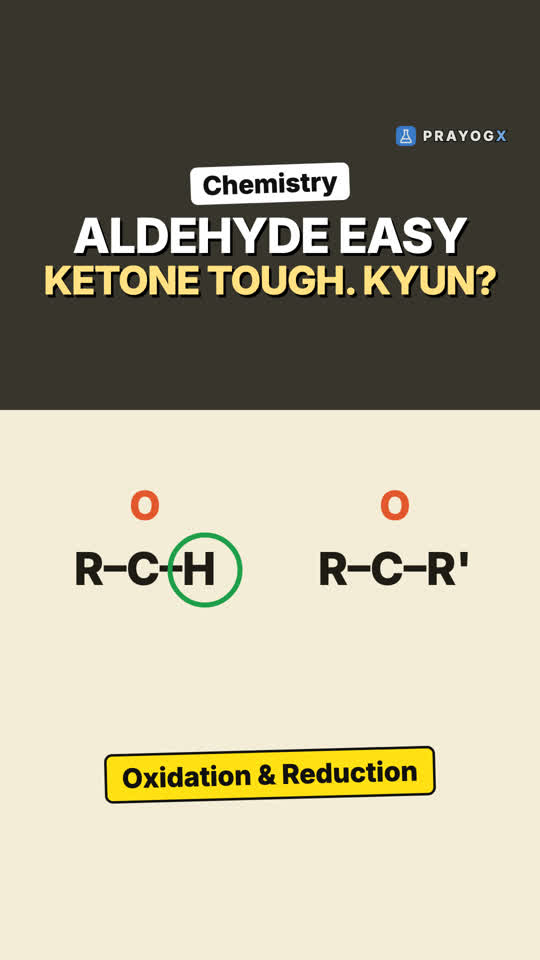 Reducing and Oxidising Aldehydes and KetonesReduction is easy for both aldehydes and ketones, but in oxidation the aldehyde reacts at once and the ketone resists. The reason is one H atom.Chemistry · simulation
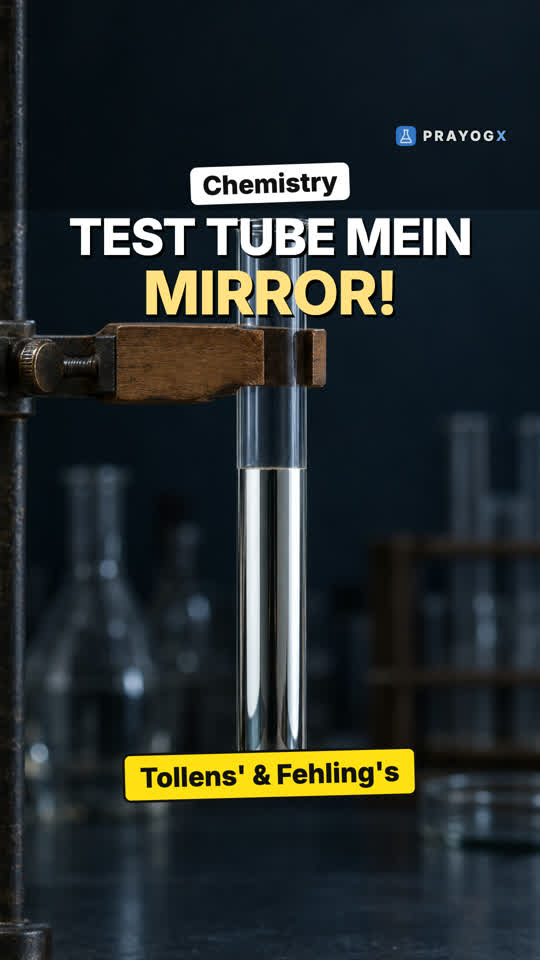 Tollens' and Fehling's TestsWarm a clear liquid and a mirror forms in the test tube. How Tollens' and Fehling's tests tell aldehydes from ketones.Chemistry · simulation
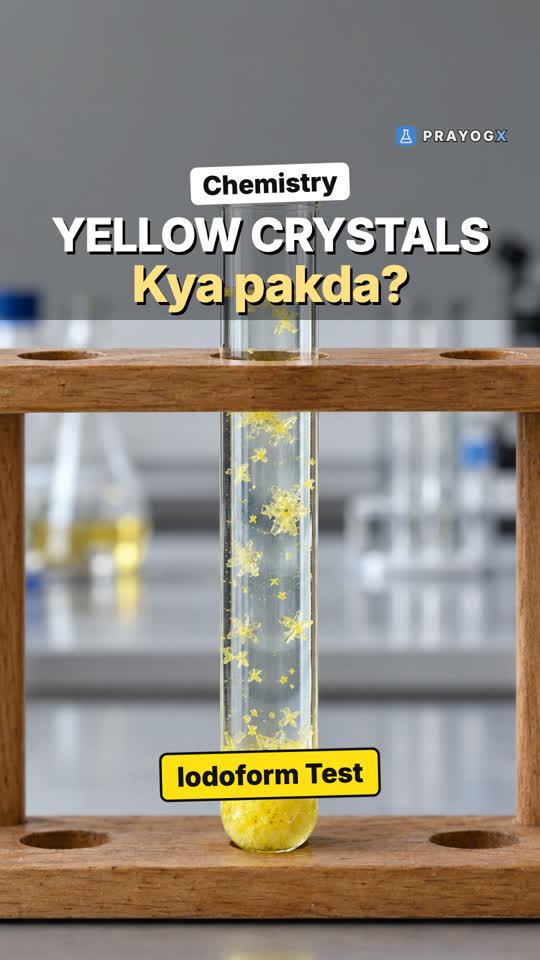 The Haloform Reaction: Iodoform TestYellow crystals with a hospital smell reveal the CH₃CO group. How the iodoform test works and which compounds pass it.Chemistry · simulation
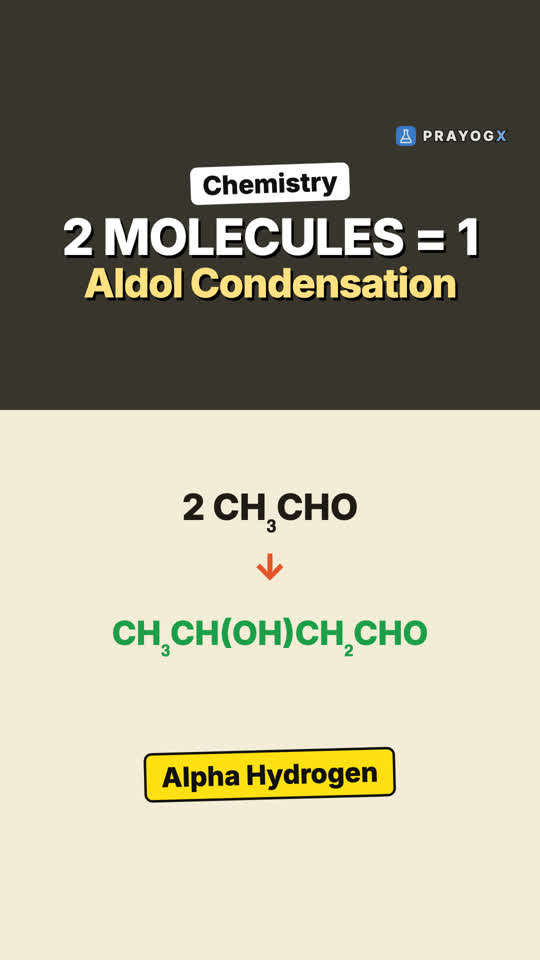 Aldol Condensation: The Alpha Hydrogen KeyTwo small ethanal molecules join into one bigger molecule. How the alpha hydrogen makes it happen, and which compounds cannot do it.Chemistry · simulation
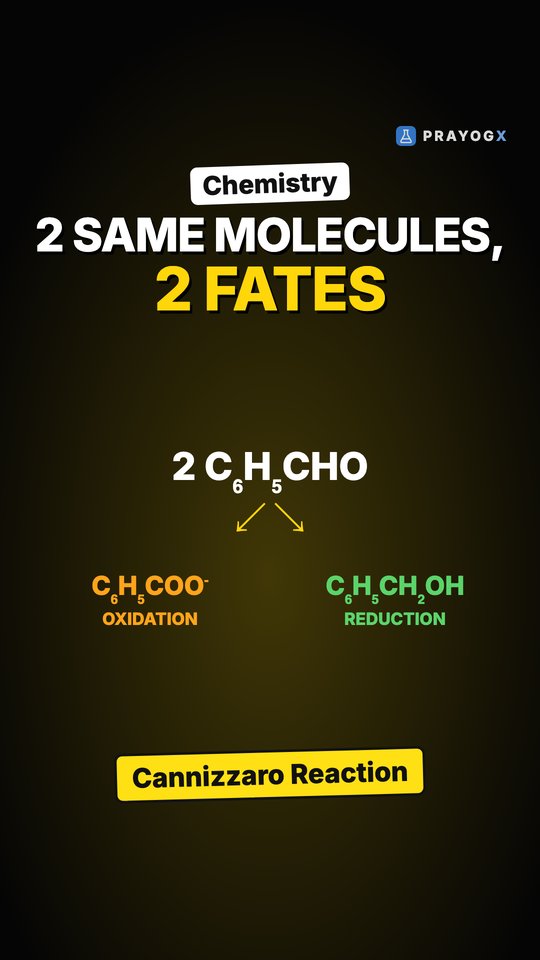 The Cannizzaro ReactionTwo identical aldehyde molecules, two different products. How an aldehyde with no α-hydrogen, in concentrated alkali, is oxidised and reduced in the same reaction.Chemistry · simulation
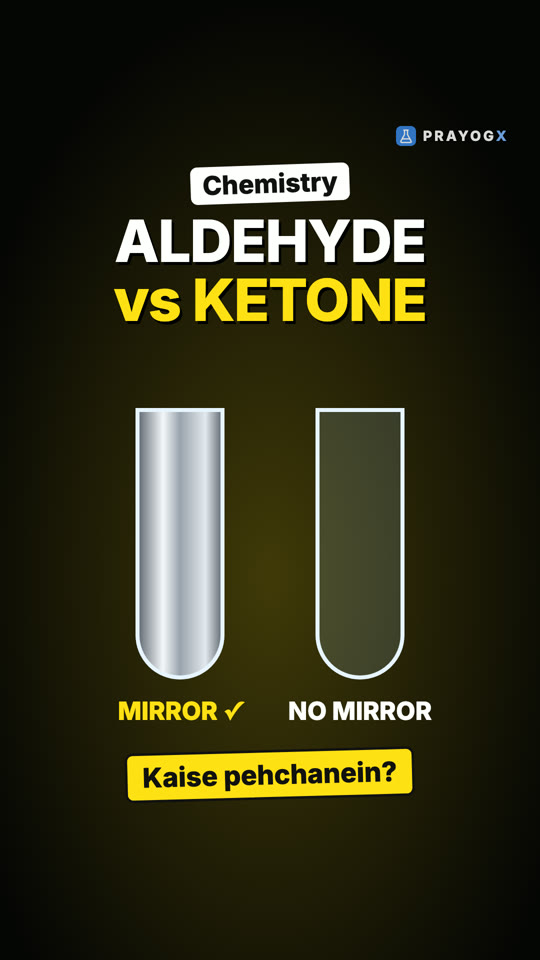 Aldehyde or Ketone? The Distinguishing TestsTwo colourless compounds, both with C=O. How Tollens', Fehling's and the iodoform test tell an aldehyde from a ketone, and why they work.Chemistry · simulation
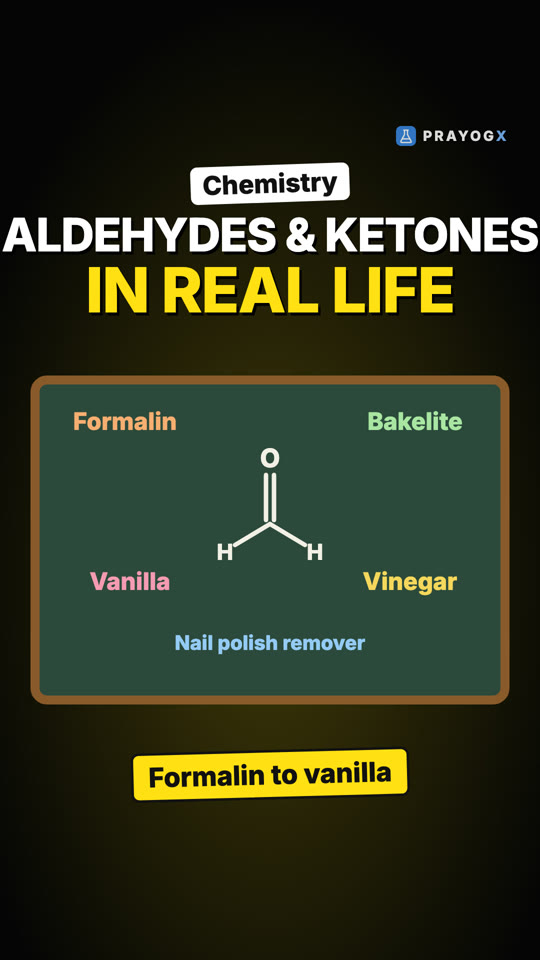 Uses of Aldehydes and Ketones: From Formalin to VanillaWhere aldehydes and ketones turn up in daily life: formalin and Bakelite from formaldehyde, acetic acid from acetaldehyde, acetone as a solvent, and vanillin, cinnamaldehyde and benzaldehyde as smells and flavours, each explained from its C=O group.Chemistry
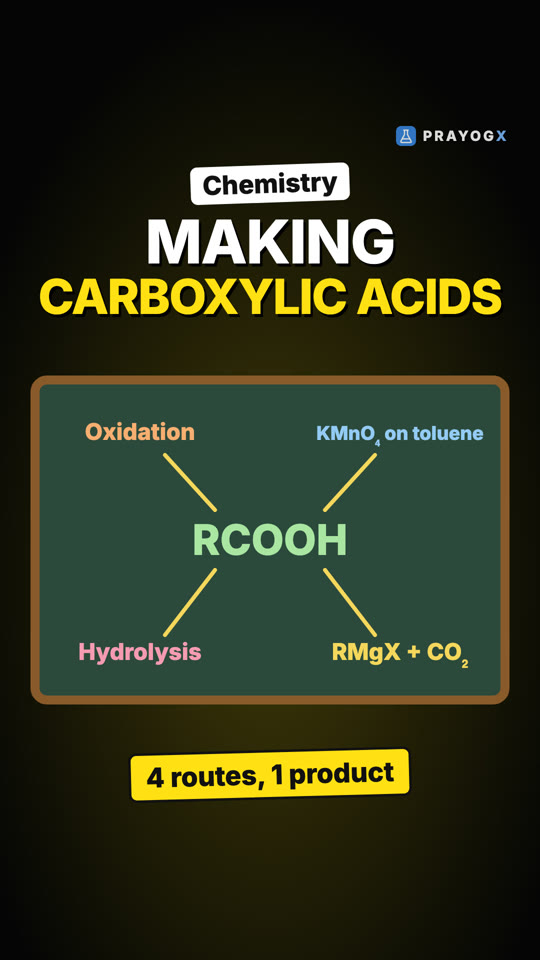 Preparing Carboxylic Acids: Four RoutesFour ways to make a carboxylic acid: oxidising primary alcohols and aldehydes, oxidising alkylbenzenes, hydrolysing nitriles and esters, and adding a Grignard reagent to dry ice, which adds one carbon (mechanism with curved arrows).Chemistry
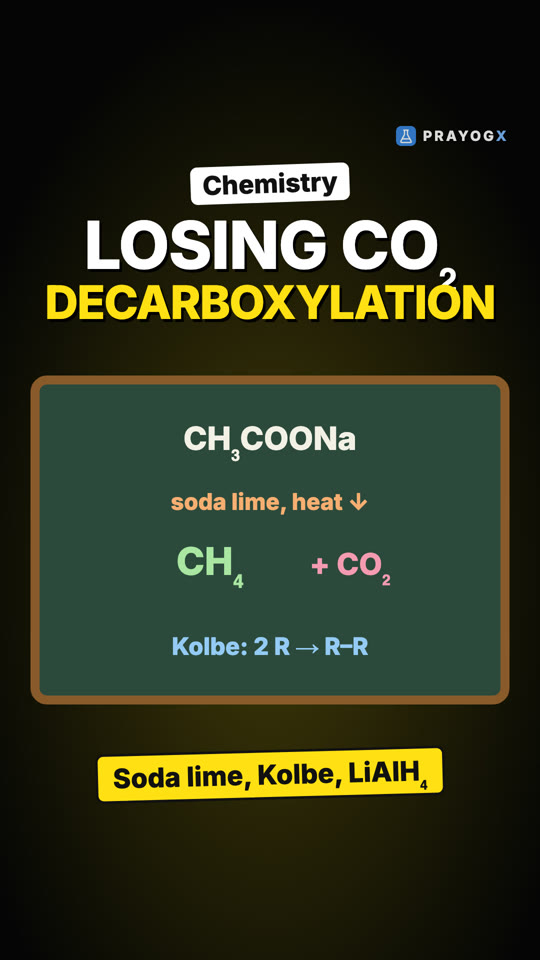 Losing CO₂: Decarboxylation, Kolbe Electrolysis and ReductionHow the –COOH group itself changes: soda lime removes it as CO₂ (one carbon less), Kolbe electrolysis joins two alkyl groups, and LiAlH₄ or diborane reduces it to a primary alcohol, while NaBH₄ cannot.Chemistry
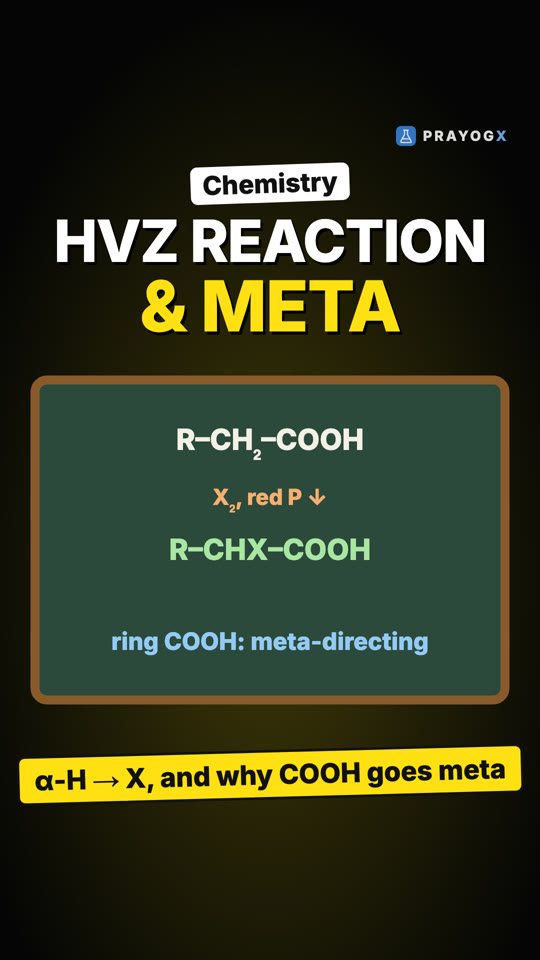 HVZ Reaction and Why Benzoic Acid Goes MetaTwo places a carboxylic acid can be substituted: the α-carbon (HVZ: X₂ and red phosphorus, then water) and the benzene ring of an aromatic acid, where –COOH is deactivating and meta-directing and blocks Friedel-Crafts reactions.Chemistry
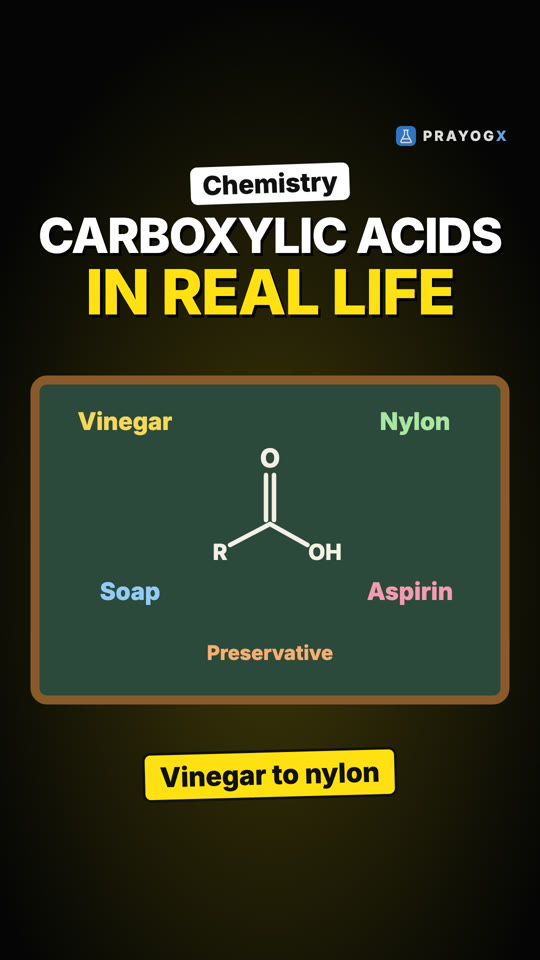 Vinegar to Nylon: Uses of Carboxylic AcidsWhere carboxylic acids are used: formic acid in industry, acetic acid as a solvent and vinegar, adipic acid for nylon-6,6 through amide links, sodium benzoate as a food preservative, fatty-acid salts as soap, and aspirin as a medicine.Chemistry
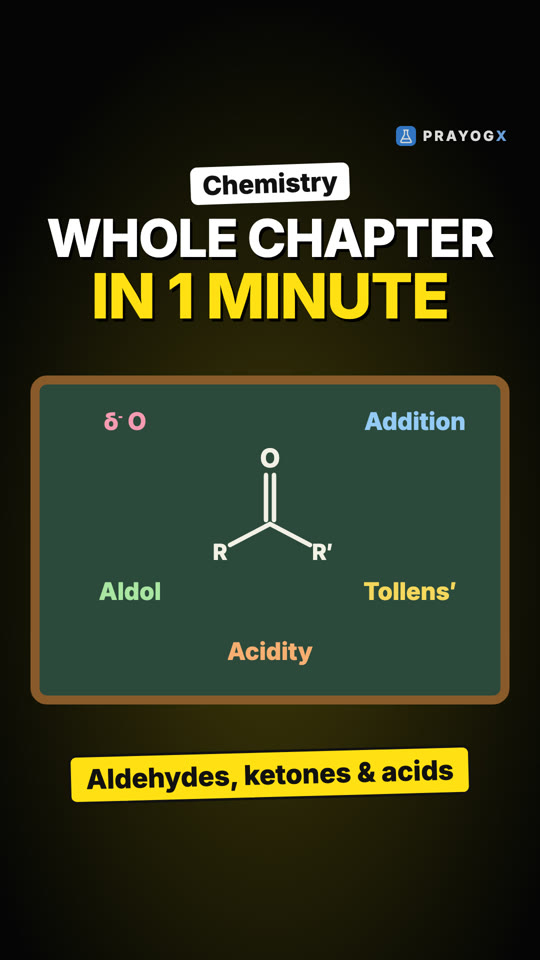 Aldehydes, Ketones and Carboxylic Acids: The Whole Chapter in One MinuteThe chapter in one place: the polar, planar C=O group; how aldehydes and ketones are made; nucleophilic addition; aldol and Cannizzaro; Tollens' and Fehling's tests; and why carboxylic acids are acidic.Chemistry