Aldehyde or Ketone? The Distinguishing Tests
Video not playing? YouTube
Two colourless compounds, both with C=O. How Tollens', Fehling's and the iodoform test tell an aldehyde from a ketone, and why they work.
Download the short notesPDF, 194 KB · solved examples, practice set and answer key Download the workbook
PDF, 181 KB · fill in the blanks, true/false, assertion-reason, MCQ, numericals, short answer, match the columns; detailed solutions at the end Up next in this chapter
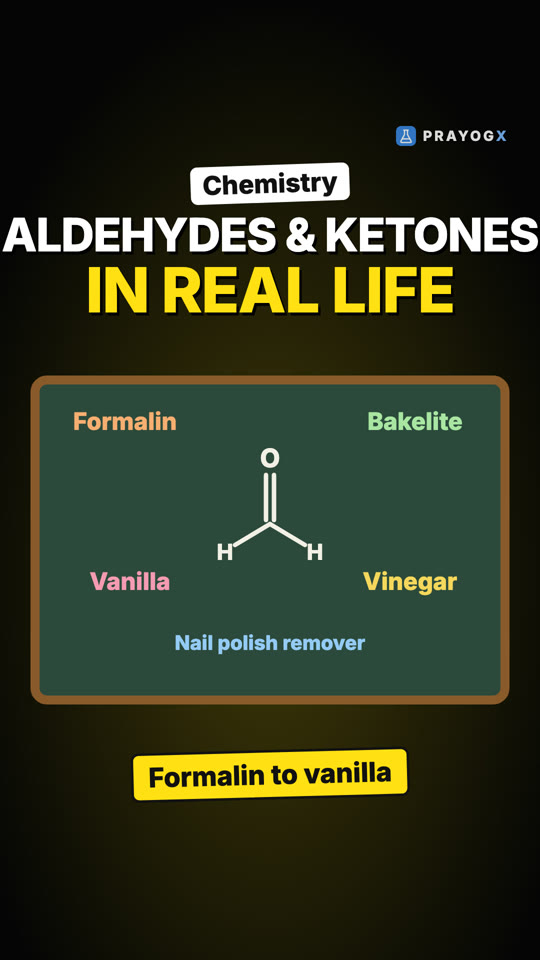 Uses of Aldehydes and Ketones: From Formalin to VanillaWhere aldehydes and ketones turn up in daily life: formalin and Bakelite from formaldehyde, acetic acid from acetaldehyde, acetone as a solvent, and vanillin, cinnamaldehyde and benzaldehyde as smells and flavours, each explained from its C=O group.Chemistry
Key points
- Aldehyde: H on the carbonyl carbon (R–CHO). Ketone: carbon on both sides (R–CO–R′).
- Aldehydes are easily oxidised; ketones resist mild oxidation. The tests use this difference.
- Tollens' test: aldehydes reduce Ag⁺ to metallic Ag, a silver mirror. Ketones generally do not.
- Fehling's test: aliphatic aldehydes reduce blue Cu²⁺ to brick-red Cu₂O. Aromatic aldehydes (benzaldehyde) generally do not.
- Iodoform test (I₂/NaOH): compounds with CH₃CO– give yellow CHI₃: methyl ketones, and ethanal, the one aldehyde that does.
Why the silver mirror forms
In Tollens' test the aldehyde is oxidised to a carboxylate ion while silver ions gain electrons and are reduced to metallic silver, which coats the glass:
RCHO + 2[Ag(NH₃)₂]⁺ + 3OH⁻ → RCOO⁻ + 2Ag + 4NH₃ + 2H₂O
Fehling's test works the same way with copper: RCHO + 2Cu²⁺ + 5OH⁻ → RCOO⁻ + Cu₂O + 3H₂O.
Choosing tests
| Compound | Tollens' | Fehling's | Iodoform |
|---|---|---|---|
| Propanal CH₃CH₂CHO | + | + | – |
| Benzaldehyde C₆H₅CHO | + | – | – |
| Ethanal CH₃CHO | + | + | + |
| Propanone CH₃COCH₃ | – | – | + |
| Pentan-3-one C₂H₅COC₂H₅ | – | – | – |
| Acetophenone C₆H₅COCH₃ | – | – | + |
Start with Tollens' for aldehyde versus ketone; use Fehling's to separate aliphatic from aromatic aldehydes, and iodoform to find a CH₃CO– group. Results are general rules under ordinary conditions; α-hydroxy ketones are an exception to the Tollens'/Fehling's rule.
Try it yourself
Goal: Identify each mystery carbonyl compound as an aldehyde or a ketone with as few tests as possible, and see why each result follows from its structure.
- Read the mystery compound's formula.
- Run one test and read the tube.
- Run more tests only if you need them.
- Decide: aldehyde or ketone.
- Try benzaldehyde, ethanal and acetophenone: which single test would have fooled you?
Quick quiz
5 questions. Choose an answer for each, then submit to see your score and the explanations.
More from Aldehydes, Ketones and Carboxylic Acids
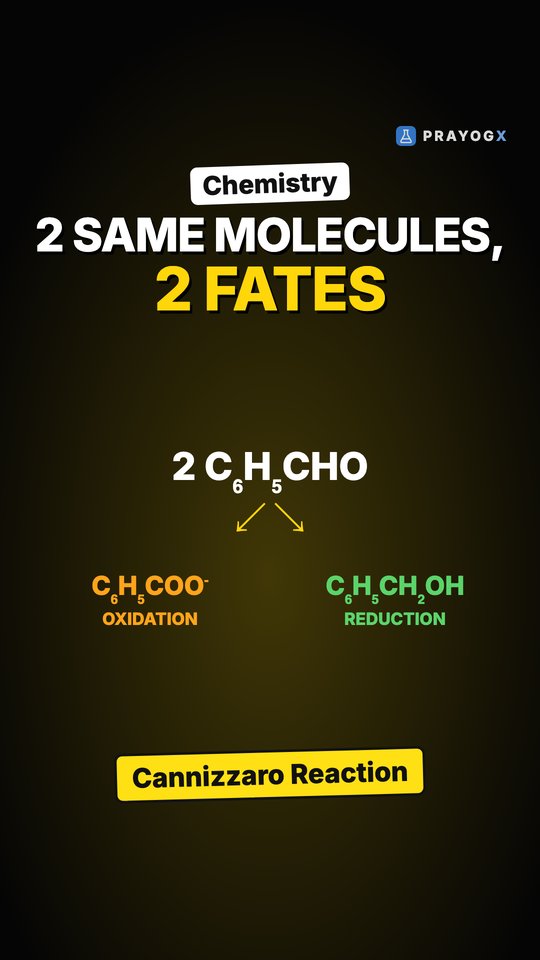 The Cannizzaro ReactionTwo identical aldehyde molecules, two different products. How an aldehyde with no α-hydrogen, in concentrated alkali, is oxidised and reduced in the same reaction.Chemistry · simulation
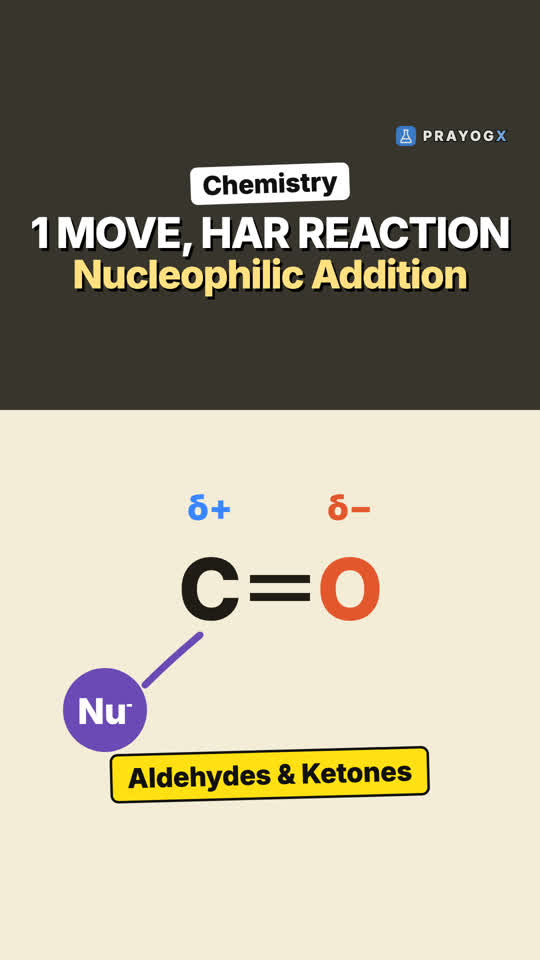 Nucleophilic Addition to the Carbonyl GroupMost reactions of aldehydes and ketones begin with one move. How a nucleophile attacks the polar C=O, and why aldehydes react faster than ketones.Chemistry
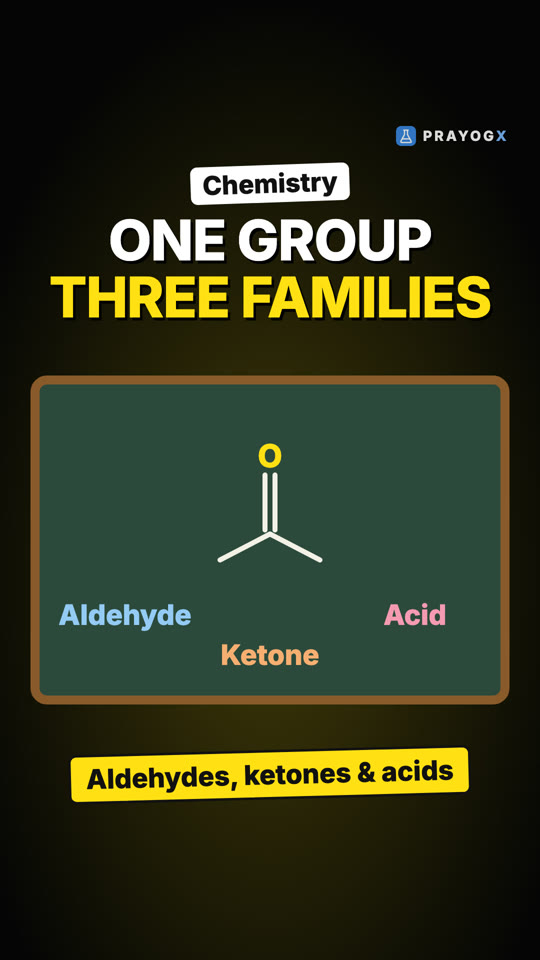 Aldehydes, Ketones and Carboxylic Acids: Chapter IntroductionVanilla, cinnamon, vinegar and nail-polish remover share one secret: the carbonyl group, C=O. What sits on the carbonyl carbon makes an aldehyde, a ketone or a carboxylic acid, and what this chapter will cover.Chemistry
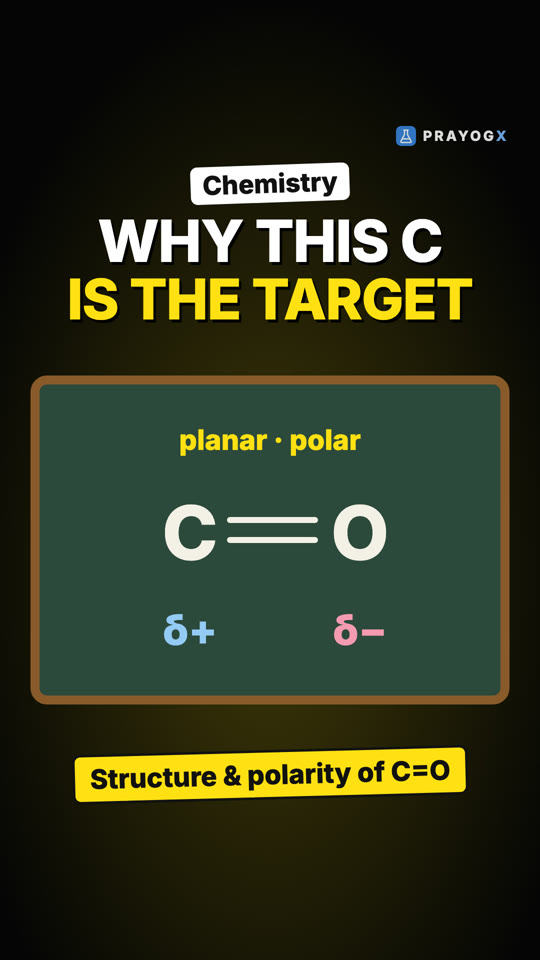 The Carbonyl Group: Structure and PolarityWhy the carbon of C=O is every nucleophile's target: an sp², planar carbon, a π bond from sideways p–p overlap, and a polar C=O with δ⁺ carbon and δ⁻ oxygen, explained by resonance.Chemistry
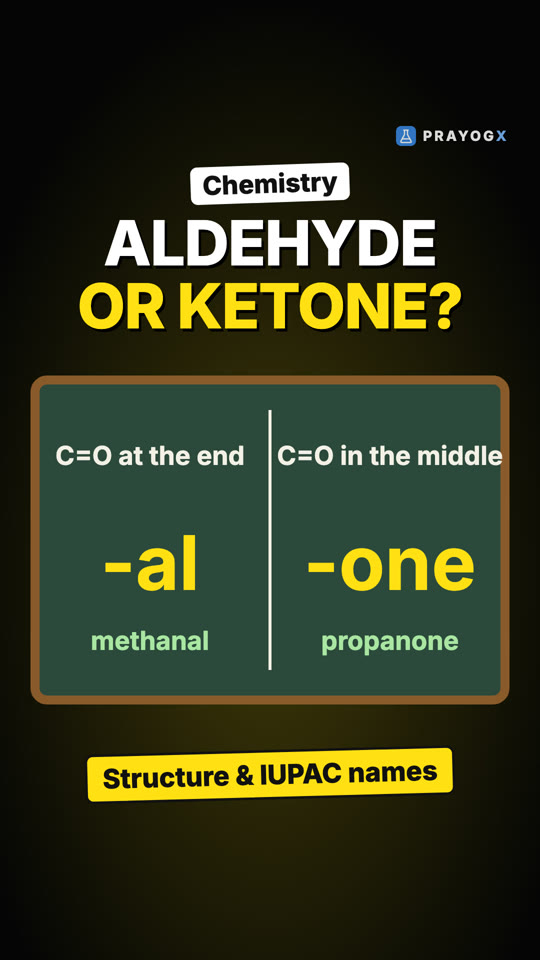 Aldehyde or Ketone? Structure and IUPAC NamesMethanal and propanone both have C=O, yet one is an aldehyde and one a ketone. Where the C=O sits decides it, and the names follow: -al for aldehydes, -one for ketones, plus the common names.Chemistry
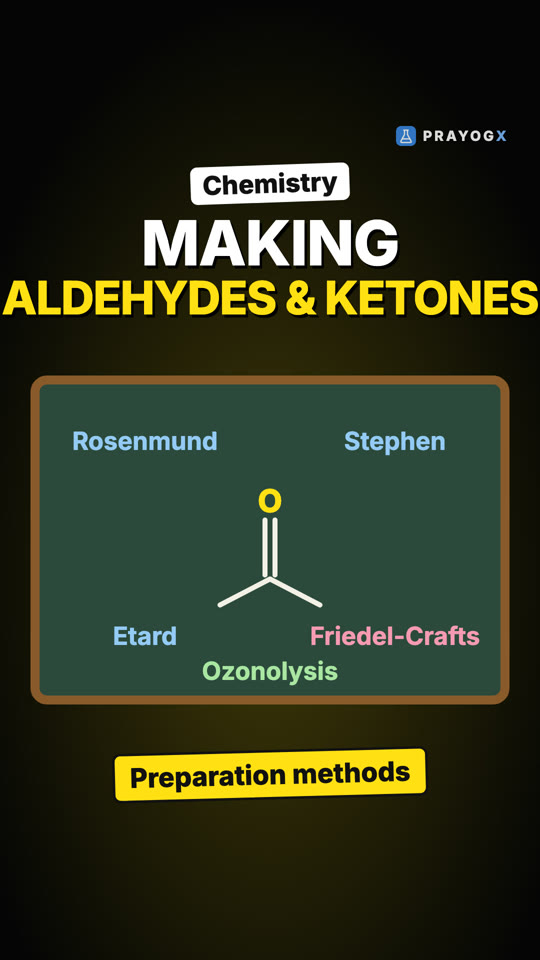 Making Aldehydes and Ketones: Methods and Named ReactionsFour routes make both aldehydes and ketones (from alcohols, alkenes and alkynes); named reactions make only one: Rosenmund, Stephen, Etard and Gatterman-Koch for aldehydes; Grignard on nitriles, dialkylcadmium and Friedel-Crafts acylation for ketones.Chemistry
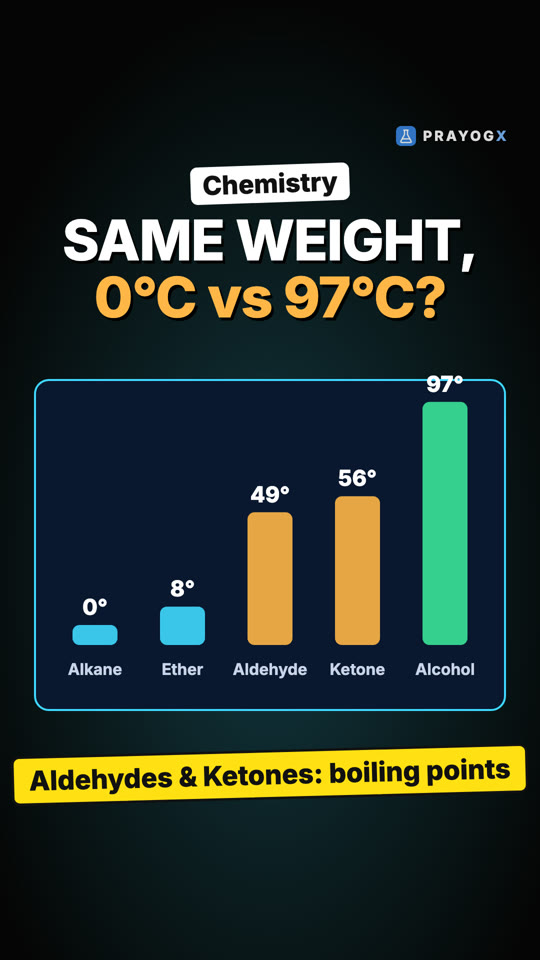 Same Weight, 0 °C vs 97 °C: Physical Properties of Aldehydes and KetonesFive compounds of the same mass boil from 0 °C to 97 °C. Aldehydes and ketones sit in the middle: their polar C=O gives dipole-dipole attraction, but with no O–H they cannot hydrogen-bond with each other. Water can hydrogen-bond to the C=O oxygen, so small aldehydes and ketones mix with water while long chains do not.Chemistry
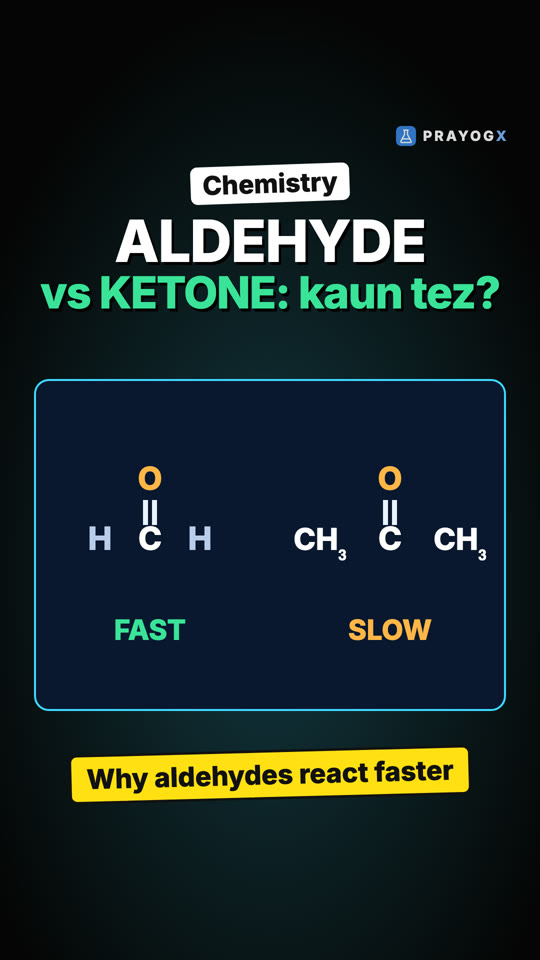 Aldehyde vs Ketone: Why Aldehydes React FasterBoth have the same C=O, yet a nucleophile attacks an aldehyde faster. Two reasons: alkyl groups push electrons (+I) and lower the carbonyl carbon's δ+, and a ketone's two groups crowd the path to it. So HCHO > CH₃CHO > CH₃COCH₃.Chemistry
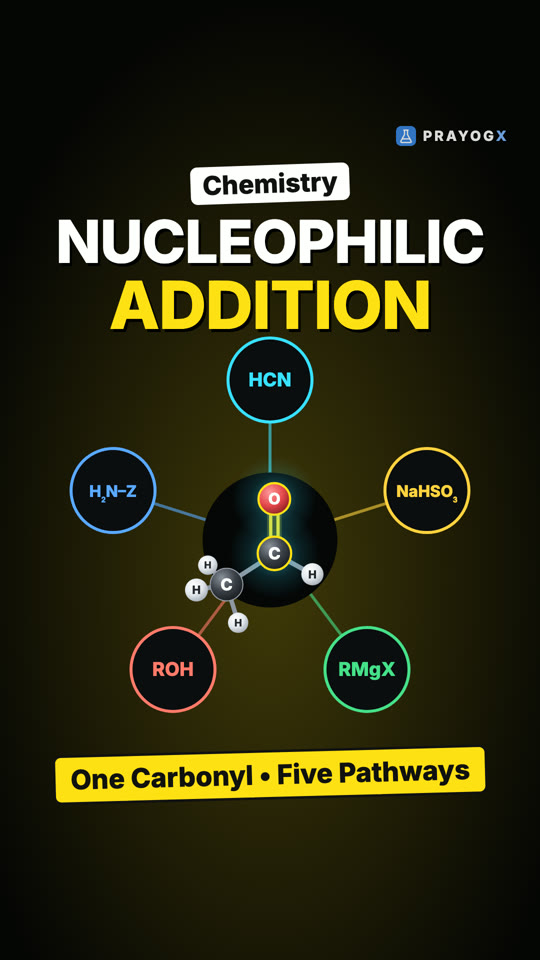 Nucleophilic Addition Reactions: One Carbonyl, Five PathwaysEvery nucleophilic addition reaction of aldehydes and ketones in one place: HCN, NaHSO₃, Grignard reagents, alcohols, and the addition–elimination of ammonia derivatives, with the product each one gives.Chemistry · simulation
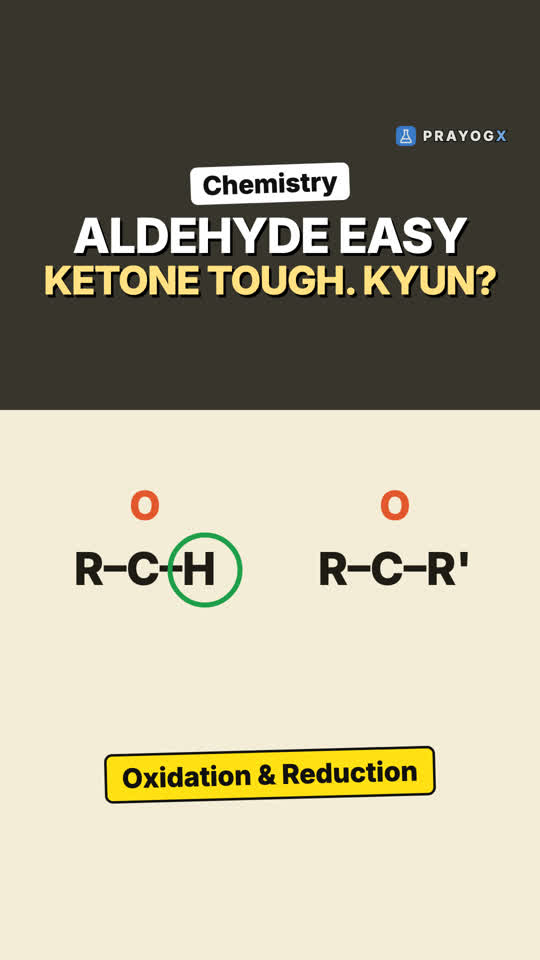 Reducing and Oxidising Aldehydes and KetonesReduction is easy for both aldehydes and ketones, but in oxidation the aldehyde reacts at once and the ketone resists. The reason is one H atom.Chemistry · simulation
 Tollens' and Fehling's TestsWarm a clear liquid and a mirror forms in the test tube. How Tollens' and Fehling's tests tell aldehydes from ketones.Chemistry · simulation
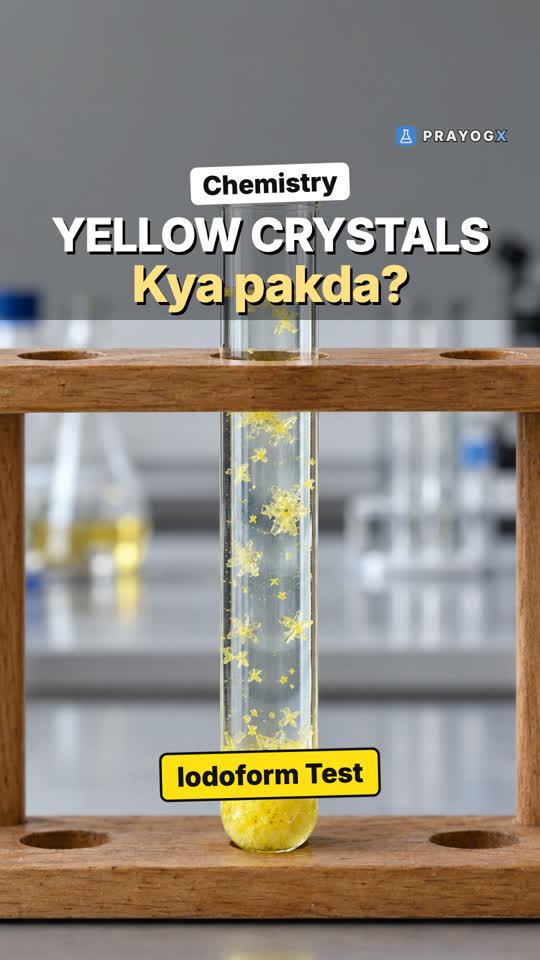 The Haloform Reaction: Iodoform TestYellow crystals with a hospital smell reveal the CH₃CO group. How the iodoform test works and which compounds pass it.Chemistry · simulation
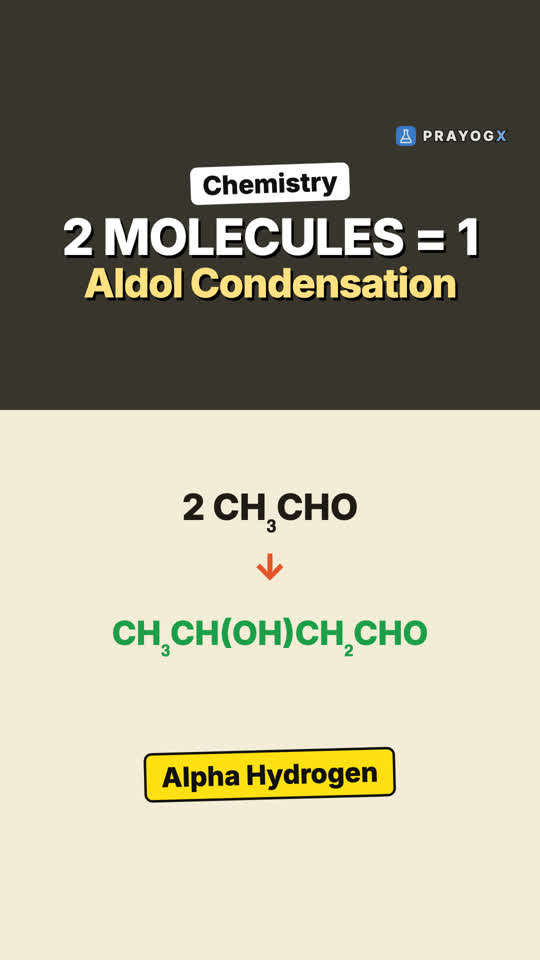 Aldol Condensation: The Alpha Hydrogen KeyTwo small ethanal molecules join into one bigger molecule. How the alpha hydrogen makes it happen, and which compounds cannot do it.Chemistry · simulation
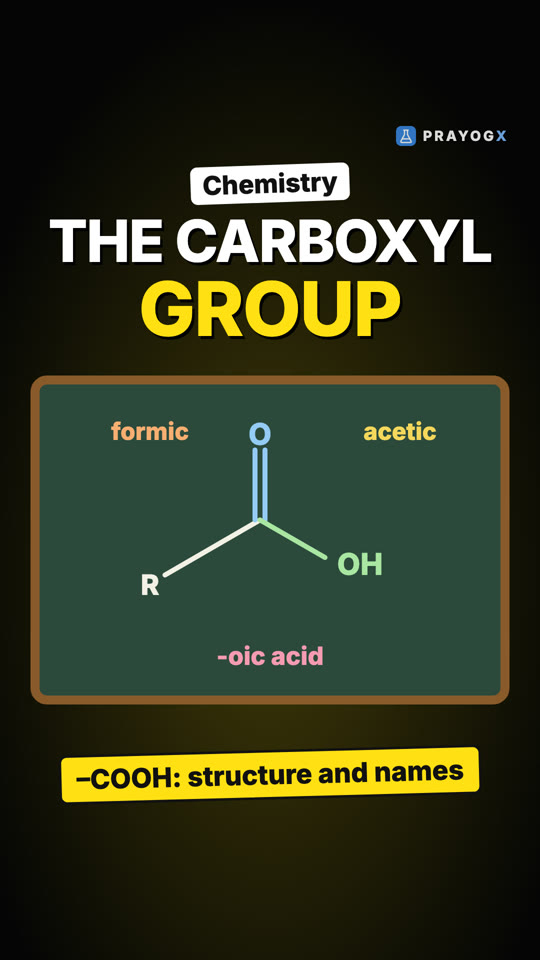 The Carboxyl Group: Structure and NamingWhat –COOH really is: a carbonyl and a hydroxyl on one sp² carbon, joined by resonance that makes the carbon less electrophilic than in aldehydes; and how carboxylic acids get their common and IUPAC names.Chemistry
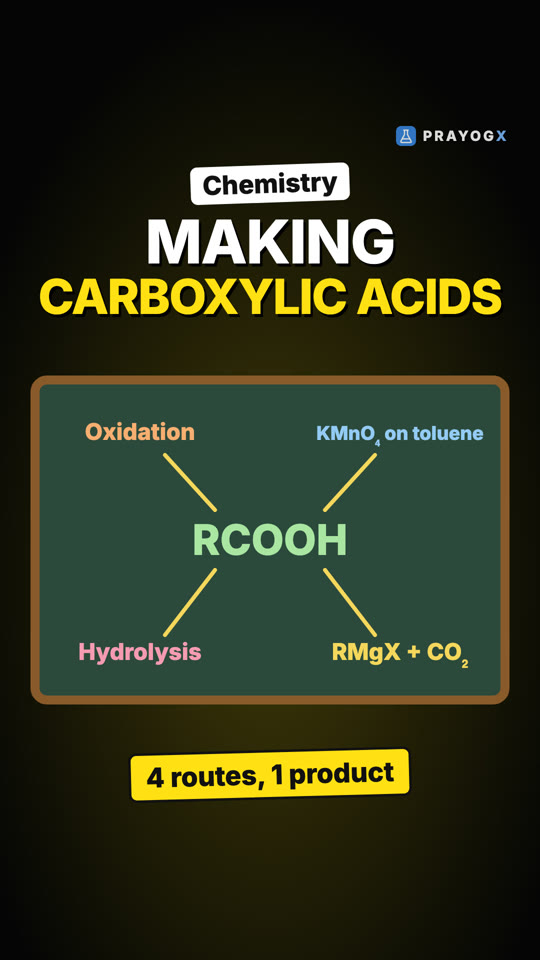 Preparing Carboxylic Acids: Four RoutesFour ways to make a carboxylic acid: oxidising primary alcohols and aldehydes, oxidising alkylbenzenes, hydrolysing nitriles and esters, and adding a Grignard reagent to dry ice, which adds one carbon (mechanism with curved arrows).Chemistry
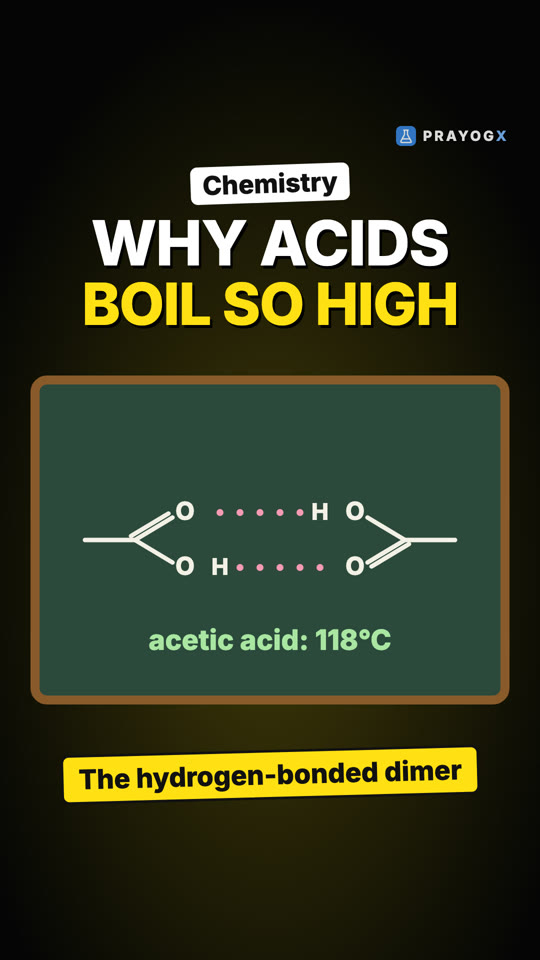 Why Carboxylic Acids Boil So High: Hydrogen-Bonded DimersFour molecules of about the same mass boil from 0 °C to 118 °C. Carboxylic acids win because two hydrogen bonds join them into dimers that survive even in the vapour; the same dimers double acetic acid's measured molar mass in benzene.Chemistry
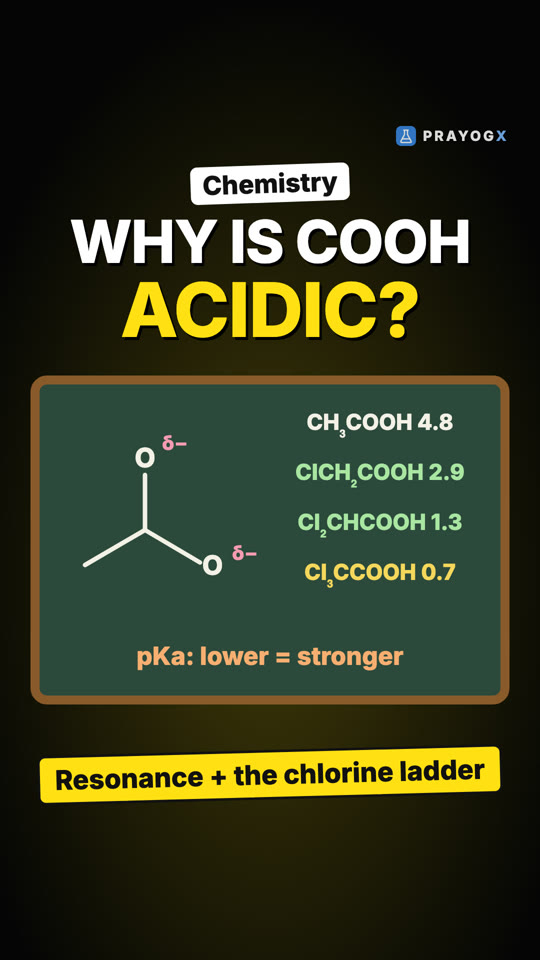 Why Carboxylic Acids Are Acidic: Resonance and SubstituentsWhy vinegar fizzes with baking soda: the carboxylate ion shares its charge equally between two oxygens (resonance, arrow by arrow), which makes carboxylic acids stronger than phenols and alcohols; electron-withdrawing groups such as chlorine make them stronger still.Chemistry
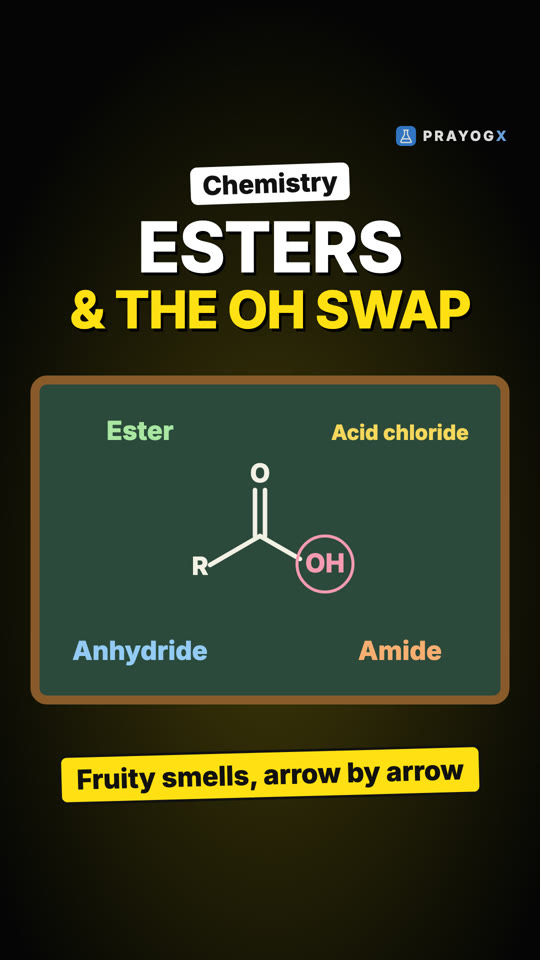 Esterification and the C–OH Swap: Esters, Acid Chlorides, Anhydrides, AmidesFruity esters from an acid and an alcohol, with the acid-catalysed mechanism drawn arrow by arrow, and three more ways to replace the –OH of –COOH: acid chlorides (best with SOCl₂), anhydrides and amides.Chemistry
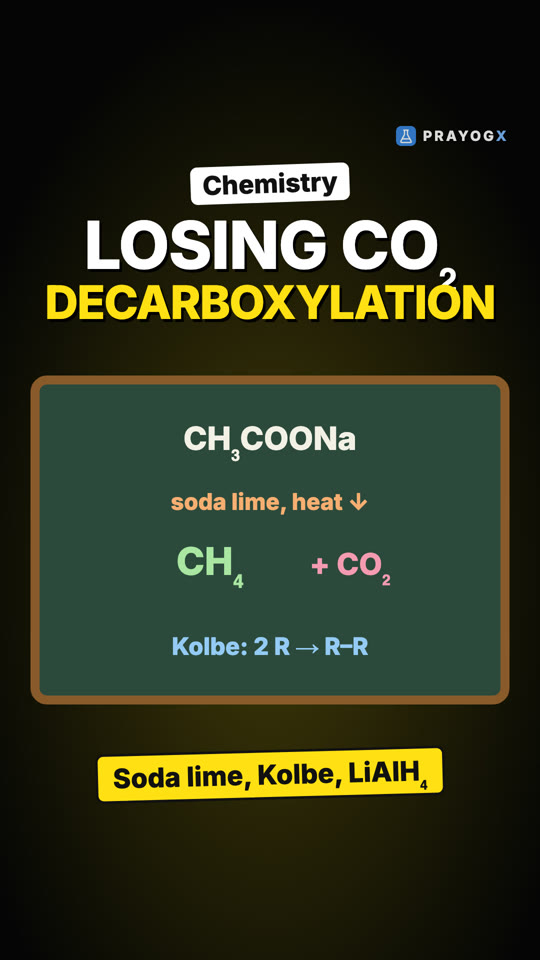 Losing CO₂: Decarboxylation, Kolbe Electrolysis and ReductionHow the –COOH group itself changes: soda lime removes it as CO₂ (one carbon less), Kolbe electrolysis joins two alkyl groups, and LiAlH₄ or diborane reduces it to a primary alcohol, while NaBH₄ cannot.Chemistry
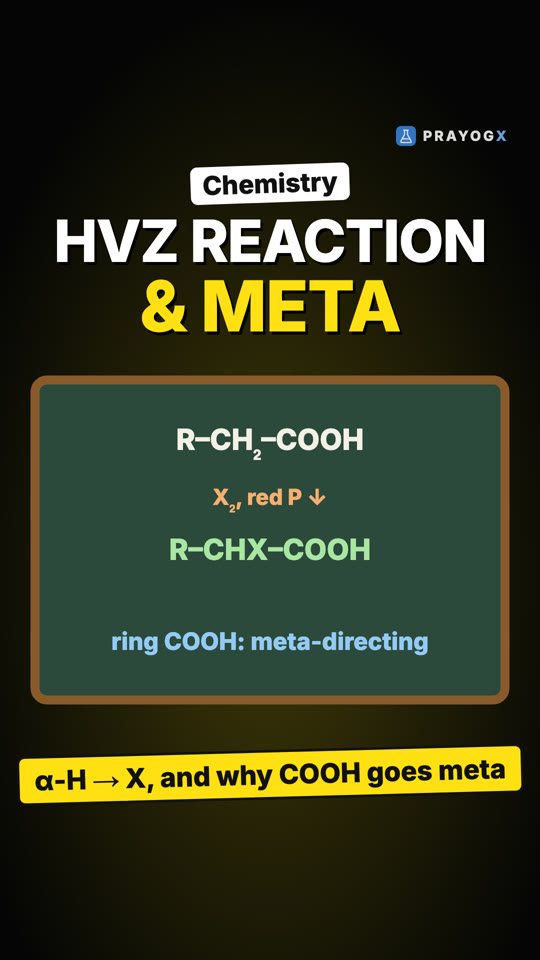 HVZ Reaction and Why Benzoic Acid Goes MetaTwo places a carboxylic acid can be substituted: the α-carbon (HVZ: X₂ and red phosphorus, then water) and the benzene ring of an aromatic acid, where –COOH is deactivating and meta-directing and blocks Friedel-Crafts reactions.Chemistry
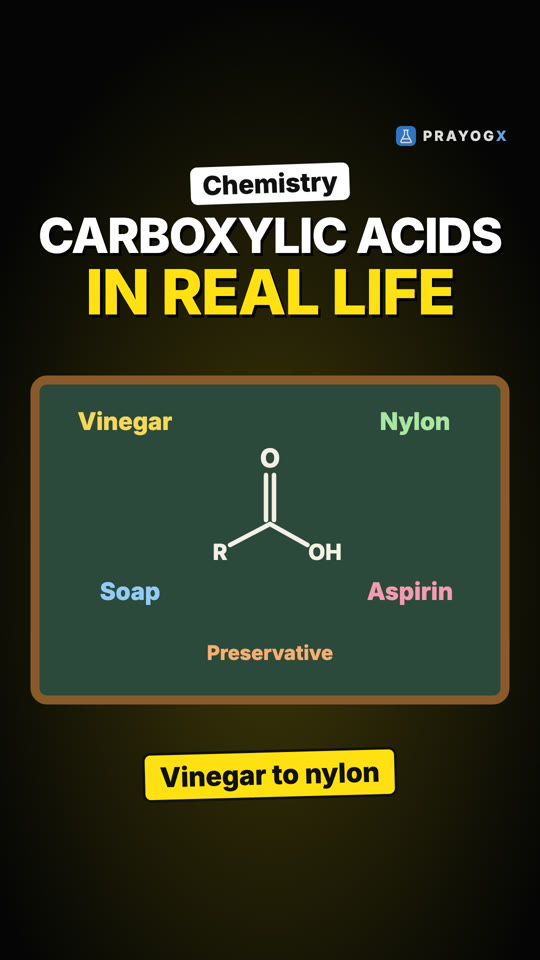 Vinegar to Nylon: Uses of Carboxylic AcidsWhere carboxylic acids are used: formic acid in industry, acetic acid as a solvent and vinegar, adipic acid for nylon-6,6 through amide links, sodium benzoate as a food preservative, fatty-acid salts as soap, and aspirin as a medicine.Chemistry
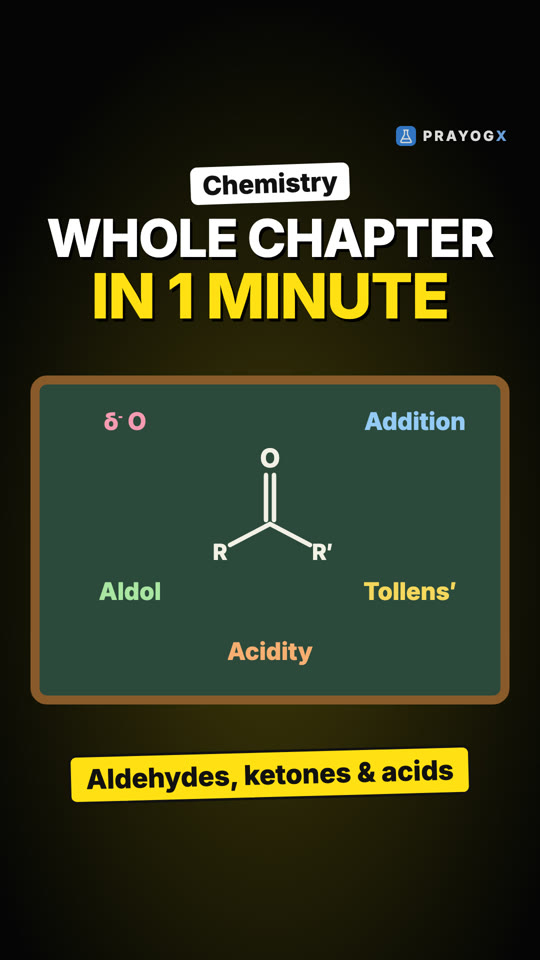 Aldehydes, Ketones and Carboxylic Acids: The Whole Chapter in One MinuteThe chapter in one place: the polar, planar C=O group; how aldehydes and ketones are made; nucleophilic addition; aldol and Cannizzaro; Tollens' and Fehling's tests; and why carboxylic acids are acidic.Chemistry